
DBX 1231 Dual 31-Band EQ: Australian Technical Guide 2026
DBX 1231 Dual 31-Band EQ: Australian Technical Guide 2026
The DBX 1231 sits in a category that refuses to disappear from Australian racks, despite the relentless march of digital DSP. A dual-channel, 31-band, third-octave graphic equaliser built around constant-Q filters and a discreet, low-noise signal path remains a critical tool for FOH engineers, install techs and tour managers who need predictable, repeatable analogue tone-shaping. This guide pulls the 1231 apart spec by spec, contextualises it against the wider EQ market, and explains where it earns its place in 2026 — and where it doesn't.
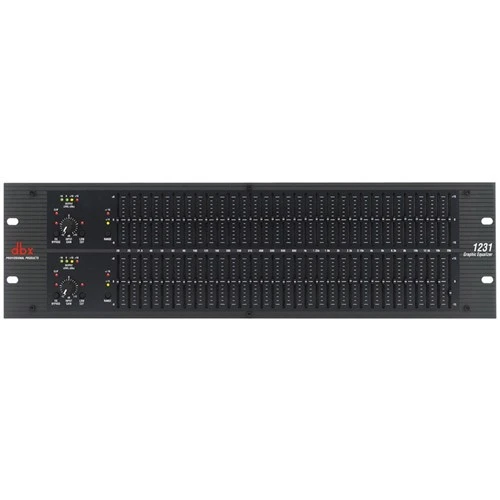
Whether you're tuning a wedge monitor at a Sydney pub gig, ringing out a school auditorium in Adelaide, or building a permanent install in a Melbourne function venue, the 1231's behaviour under real-world load is what matters — not just the figures on the data sheet. We'll cover both.
Technical Overview: What the DBX 1231 Actually Is
The 1231 is the modern successor to the long-running 2231 platform. It's a 2U rack unit housing two independent 31-band graphic EQs, each with sliders centred on standard ISO third-octave frequencies from 20 Hz to 20 kHz. Beyond the band sliders, each channel offers an input gain trim, a switchable 50 Hz or 120 Hz high-pass (low-cut) filter, a +/-6 dB / +/-12 dB range switch, an EQ in/out bypass, and a clip/signal LED ladder.
What separates the 1231 from generic graphic EQs is its filter topology. DBX uses constant-Q (sometimes called proportional-Q variants in older marketing) filters that maintain bandwidth regardless of cut or boost amount. This matters in live sound because what you adjust on a slider is closer to what you hear — fewer surprises when a 2 kHz cut at -3 dB behaves nothing like the same cut at -9 dB on a non-constant-Q unit.
Headline Specifications
| Specification | Value | Real-World Implication |
|---|---|---|
| Channels | 2 (independent) | Stereo programme or dual mono (e.g. L/R mains, or two monitor mixes) |
| Bands per Channel | 31, ISO third-octave | Surgical control across the full audio band |
| Frequency Range | 20 Hz to 20 kHz | Covers full programme audio without HF roll-off issues |
| Boost/Cut Range | +/-6 dB or +/-12 dB (switchable) | +/-6 dB mode improves slider resolution for fine work |
| Filter Type | Constant-Q | Predictable bandwidth across slider travel |
| Frequency Response | 20 Hz - 20 kHz, +/-0.5 dB (EQ flat) | Effectively transparent in bypass |
| Dynamic Range | >108 dB (unweighted) | Quiet enough for high-headroom installs |
| THD+N | <0.005% @ +4 dBu, 1 kHz | Clean signal path; no audible distortion |
| Maximum Input/Output Level | +21 dBu | Significant headroom; survives hot pro signals |
| High-Pass Filter | 50 Hz or 120 Hz, switchable | Stage-rumble removal without touching sliders |
| Connectivity | XLR + 1/4" TRS, balanced in/out per channel | Compatible with virtually any pro signal chain |
| Form Factor | 2U, 19-inch rack | Standard touring/install rack fitment |
Filter Design: Why Constant-Q Matters in Live Sound
Graphic EQs broadly split into two filter families: variable-Q (proportional-Q) and constant-Q. On a variable-Q design, small slider movements produce wide, gentle filters; large movements produce narrower, more surgical ones. This sounds friendly on paper but means you cannot reliably predict how a notch will behave at intermediate settings. Engineers ringing out monitors typically prefer the opposite: a narrow filter at -3 dB that behaves the same shape as a narrow filter at -9 dB.
The 1231's constant-Q filters keep bandwidth roughly fixed (around 1/3 octave at the -3 dB points) regardless of slider position. The practical effect is faster, more confident feedback control. When you find a ringing frequency, you know that pulling that slider down 4 dB will reduce that frequency by 4 dB — not collapse half an octave around it. For touring engineers running multiple wedge mixes, this consistency is genuinely useful.
The +/-6 dB vs +/-12 dB Switch
One of the under-appreciated features of the 1231 is the per-channel range switch. In +/-6 dB mode, each slider's full travel maps to only +/-6 dB instead of +/-12 dB, effectively doubling the resolution under your fingers. For tonal sweetening on mains in a calibrated install, this is the mode you want. For monitor work where you might need decisive cuts to chase down feedback, +/-12 dB earns its keep. Few competing units offer this switching as cleanly.
The Signal Path and Why It Sounds the Way It Does
DBX has built the 1231 around a discreet, low-noise op-amp-based signal path with servo-balanced inputs and outputs. The benefit of servo-balancing — versus transformer-balancing — is wider bandwidth, better LF extension and lower distortion, at the cost of slightly less common-mode rejection in extreme RFI environments. For most Australian live and install applications, servo-balancing is the right trade-off.
Real-world performance shows up as:
- Quiet noise floor: >108 dB dynamic range means the unit doesn't add hiss in normal gain-staging
- High headroom: +21 dBu maximum levels allow it to sit between a hot console output and an amplifier without intermediate pad attenuation
- Predictable summing: band-to-band interaction is well-controlled — adjacent slider moves combine in the way you'd expect
- Transparent bypass: with EQ disengaged, the unit is effectively a wire, useful for A/B comparisons during system tuning
Performance Evaluation: Real-World Use Cases
1. Front-of-House System EQ for Live Venues
The most common application is inserting a 1231 between the FOH console output and the system amplifiers (or the input of a system processor) to shape the overall PA response to the room. Using pink noise and an RTA, an engineer can identify standing-wave build-ups in the low-mids — common in Australian club venues with hard floors and rear-wall reflections — and trim them down. The 1231's third-octave resolution is well-matched to the resolution of room modes, and the constant-Q filters mean a 200 Hz cut doesn't bleed into 160 Hz or 250 Hz to a degree that wrecks the spectral balance.
2. Monitor Wedge Ring-Out
This is where dual-channel graphic EQs traditionally live. With one channel per wedge mix (or a 1231 per pair of related mixes), you can pull problematic frequencies to suppress feedback without retreating to a digital console's parametric EQ. The +/-12 dB range, combined with the 50 Hz HPF to kill stage rumble, makes this fast work. Most experienced engineers report 6-9 dB of useable gain-before-feedback improvement against a flat starting point on a typical wedge.
3. Permanent Installations
For function venues, places of worship, school halls and corporate AV in 2026, the 1231 still earns specification slots because it is analogue, predictable, and reliable. There's no firmware to manage, no DSP licence to renew, no network drop-out to debug. Power it, set it, lock the front panel (a security cover is available), and forget it. For installs where the operator is non-technical, this is genuinely valuable.
4. Hire Stock and Touring Racks
The 1231 is a workhorse hire item. It's robust, recognisable to any visiting engineer, requires no cheat sheet, and the slider positions are visible from across a stage — useful for documentation and recall. Many Australian production companies still build standard FOH racks around a 1231, a compressor and a system processor.
Comparison: DBX 1231 vs Common Alternatives
| Feature | DBX 1231 | DBX 231s | Behringer FBQ3102HD | Klark Teknik DN360 |
|---|---|---|---|---|
| Channels | 2 | 2 | 2 | 2 |
| Bands | 31 | 31 | 31 | 30 |
| Filter Type | Constant-Q | Constant-Q | Variable-Q (with FBQ feedback detect) | Proportional-Q |
| Range Switch | +/-6 / +/-12 dB | +/-6 / +/-15 dB | Fixed +/-12 dB | Fixed +/-12 dB |
| Max Output | +21 dBu | +20 dBu | +21 dBu | +26 dBu |
| HPF | 50 / 120 Hz switchable | Fixed 40 Hz | Fixed 30 Hz | Defeatable 30 Hz |
| Build / Origin | Heavy chassis, pro | Lighter, project pro | Plastic-heavy, budget pro | Reference-grade UK build |
| Typical AU Price Tier | Mid-pro | Entry pro | Budget | High-end |
The 1231 sits comfortably between the entry-level 231s (lighter chassis, fewer feature switches) and the broadcast/install reference DN360 (which costs roughly 3-4x as much). Its closest direct rival is the Behringer FBQ3102HD, which adds an automatic feedback detection LED system but lacks constant-Q behaviour and uses lighter construction. For Australian buyers prioritising long-term reliability over per-dollar feature count, the 1231 generally wins on durability.
What to Actually Pay Attention To When Evaluating Graphic EQs
Specification sheets can mislead. Here are the metrics that matter operationally and how to interpret them:
- Filter Q behaviour: Read whether the unit is constant-Q or proportional-Q. Neither is "better" universally — but constant-Q is preferred for live sound and corrective work; proportional-Q is sometimes preferred for tonal sweetening on programme.
- Maximum output level: Below +20 dBu and you risk clipping the EQ before clipping the console. Aim for +21 dBu or higher for modern signal chains.
- HPF availability: A switchable HPF saves a slider and removes inaudible-but-power-wasting subsonic content. Look for at least one HPF option, ideally with a frequency choice.
- Range switching: The ability to drop to +/-6 dB doubles slider resolution and is genuinely useful for install work.
- Bypass quality: A true hardware bypass (not a relay-clicked DSP-bypass) is preferable for emergency fault-finding. The 1231's per-channel bypass is electronic but transparent in measurement.
- Channel independence: Confirm both channels are genuinely independent, not summed or linked. Some lower-cost dual EQs share elements internally.
Limitations and Honest Drawbacks
No product is perfect, and the 1231 has known trade-offs Australian buyers should consider before committing:
- No feedback detection: Unlike Behringer's FBQ-series, the 1231 doesn't light up the slider corresponding to a ringing frequency. Engineers rely on ear and experience instead.
- No memory or recall: Slider positions are physical only. Documenting settings means photographing the front panel or sketching them. For multi-band recall, a digital EQ wins.
- Analogue-only: No AES/EBU, no Dante, no networked audio. If your facility is moving to a fully digital backbone, a graphic on Dante (e.g. via a digital matrix processor) may be more sensible.
- Slider reliability over years: Like any graphic EQ, sliders can become noisy after years of dust ingress, particularly in dusty Australian outdoor environments. Periodic deoxidising solves this but it's a maintenance reality.
- Weight: The 2U chassis is solid, which is a feature for touring durability but adds weight to flightcased rack systems.
View the DBX 1231 at MusiconStage Australia
Setup and Operational Best Practice
Getting the most from a 1231 starts with correct gain staging. The unit's input trim is there to match it to your console's nominal output level. The standard procedure for an FOH insert:
- Engage EQ bypass on both channels.
- Run programme material at expected stage volumes through the unit.
- Adjust the input trim until the signal LED is green steady, with occasional yellow peaks but no red.
- Engage EQ.
- Make tonal adjustments only after gain staging is correct.
For monitor work, engage the 80-120 Hz HPF as a default — almost no wedge needs anything below 100 Hz, and the rumble removal alone often improves perceived clarity by several dB. Then ring out one frequency at a time, working narrow cuts of 3-6 dB rather than broad 9-12 dB drops which often kill more tone than they need to.
Future-Proofing and Long-Term Value
An honest question in 2026 is: should you still buy an analogue graphic EQ when most live consoles include 31-band graphics in their output processing? The answer depends on workflow.
If you're running a single digital console for a single venue, console graphics are probably enough. If you tour with different consoles week-to-week, share PA stock between venues, run permanent installs without a dedicated console, or simply prefer hands-on tactile control for time-critical adjustments, a hardware 1231 still earns rack space. Touring techs particularly value being able to glance at slider positions to read the room's response curve at a distance — something no digital screen replicates as quickly.
Resale value on the 1231 platform is also strong. Used 1231 units hold their price well in the Australian market because demand consistently exceeds supply for proven hire stock.
FAQs: DBX 1231 in Australian Use
Is the DBX 1231 suitable for studio use?
It's primarily a live and install tool. Studios generally prefer parametric or fully-featured channel-strip EQs for tracking and mixing. That said, the 1231 is sometimes used as a programme EQ on the mastering bus or as a room-correction EQ on monitor outputs.
Can I use the two channels independently?
Yes. The two channels are fully independent, which is why the 1231 is popular for monitor mixing — one channel per wedge mix, or one for L and one for R of a stereo PA.
Will it accept consumer (-10 dBV) gear?
It's designed for +4 dBu pro signals. Feeding it consumer-level audio is possible via the input trim but ideal noise performance comes from a properly gain-staged pro source.
How does the 50 Hz vs 120 Hz HPF choice work?
The 50 Hz HPF is gentle subsonic protection — useful on mains. The 120 Hz HPF is more aggressive and aimed at monitor wedges where there's no value in delivering low end and considerable risk of stage rumble feedback.
Is the 1231 the same as the older 2231?
No. The 1231 is a current-production update of the platform with refined circuitry, lower noise, and improved component tolerances, while retaining the operational layout that engineers know.
Recommendation: Who Should Buy the DBX 1231 in 2026?
Buy the 1231 if you are:
- An Australian sound engineer running mixed analogue/digital touring rigs who needs a reliable insert EQ
- A venue technical manager specifying a permanent install in a function room, place of worship, school hall or live music room
- A hire company building standard FOH or monitor racks where universal operator familiarity matters
- A house engineer at a small-to-medium venue who values tactile, hands-on tonal control over menu-diving
Look elsewhere if you need recallable scenes, networked audio integration, automatic feedback suppression, or the very lowest noise floor for mastering-grade work — in those cases, look at digital graphics inside a Lake or BSS BLU processor, or step up to the Klark Teknik DN360.
For the broad middle of Australian live sound and install work in 2026, the 1231 remains a confident, justifiable specification choice. It does what it says, sounds clean doing it, and is built to outlast the gigs you'll throw at it.
Check current pricing and availability on the DBX 1231 at MusiconStage Australia