
DBX 1231 Dual 31-Band EQ: Aussie Pro Sound Guide 2026
DBX 1231 Dual Channel 31-Band Equaliser: The Australian Sound Pro's Complete Guide
If you've spent any time around live sound systems, recording studios, or installed PA setups in Australia, you've almost certainly run a signal through a DBX graphic equaliser at some point. The DBX 1231 is one of those workhorse pieces of gear that quietly does its job in rack after rack across pubs, churches, function centres and touring rigs. It's a dual channel, 31-band (one-third octave) graphic EQ built for people who need precise, reliable tonal control without fuss.
This guide breaks down exactly what the DBX 1231 does, who it's genuinely suited to, where it shines, where it doesn't, and how to get the most out of it. Whether you're feedback-fighting a wedge monitor or smoothing out a room's response for a fixed install, the goal here is to help you decide whether this is the right EQ for your setup.
What Exactly Is the DBX 1231?
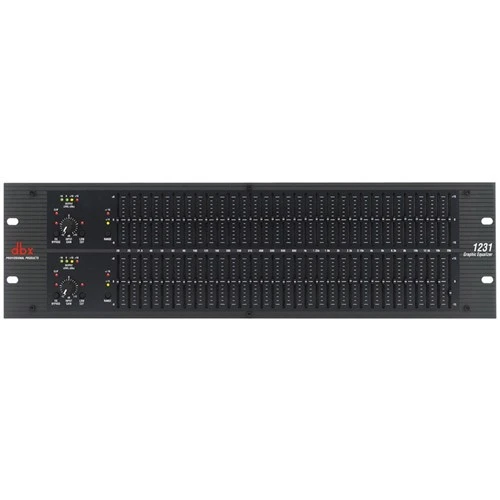
The DBX 1231 is a two-channel, 31-band graphic equaliser housed in a standard 2RU (two rack unit) chassis. Each of the two channels gives you 31 sliders, with each slider controlling a fixed frequency band spaced at one-third-octave intervals from 20Hz right up to 20kHz. That covers the entire audible spectrum in fine, even steps.
"Graphic" simply means the position of the faders gives you a visual picture of the frequency curve you've dialled in. Push a few sliders down in the low-mids and you can literally see the dip you've created. This makes it far more intuitive than a parametric EQ for a lot of practical live-sound work, especially when you're moving quickly under pressure.
Being a dual channel unit, the 1231 can handle a true stereo pair (left and right of a main PA), two separate mono sends (such as two different monitor mixes), or one channel for mains and one for a monitor, depending on what your rig needs. That flexibility is a big part of why these units stay in service for years.
Key Features Worth Understanding
- 31 bands per channel (1/3-octave): Fine resolution lets you notch out problem frequencies precisely without sacrificing huge chunks of surrounding tone.
- Switchable boost/cut range: You can select a gentler range for subtle, broad tonal shaping or a wider range when you need more aggressive correction. The narrower setting gives you finer control per slider, which is genuinely useful for delicate adjustments.
- Constant-Q filtering: The bandwidth of each filter stays consistent whether you're applying a small or large amount of cut or boost, so the EQ behaves predictably as you push sliders further.
- Balanced XLR and TRS connectivity: Professional balanced inputs and outputs keep noise down over long cable runs, which matters in real venues.
- Low and high cut filters: Onboard high-pass and low-pass filtering helps you clean up subsonic rumble and unwanted high-frequency hiss before they ever hit the graphic section.
- Front-panel bypass: Instantly compare your EQ'd signal against the unprocessed source, which is essential for honest tuning decisions.
- DBX Type III noise reduction technology: Helps keep the signal clean and the noise floor low through the processing chain.
Keen to dig into the details? View the DBX 1231 specifications and pricing with delivery across Australia.
Who Is the DBX 1231 Actually For?
This isn't a one-size-fits-all answer, so let's be specific about the people who get real value from a 1231.
Live Sound Engineers and Bands
For front-of-house and monitor duties, a 31-band graphic is still one of the fastest tools for ringing out monitors and taming a difficult room. When a floor wedge starts to feedback at a specific frequency, you can find that band and pull it down in seconds. Many engineers run one channel on the mains and use the other for a key monitor mix, or run the unit across a stereo PA.
Houses of Worship and Community Venues
Churches, halls and clubs across Australia often deal with reflective, acoustically tricky rooms. A graphic EQ inserted on the main system lets a volunteer or part-time operator smooth out boomy low-mids or harsh upper frequencies without needing deep technical training. The visual layout makes it approachable.
Installed and Fixed PA Systems
In permanent installs, the 1231 can be set once to correct a room's response and then largely left alone. Its 2RU footprint and balanced connections make it a tidy, professional fit in an equipment rack.
Studios and Rehearsal Spaces
While modern studios lean heavily on plugins, a hardware graphic EQ still earns its place for monitor correction, headphone feeds, and shaping playback systems in rehearsal rooms where a physical, hands-on tool is more practical than a screen.
Real-World Use Cases
- Ringing out stage monitors: Slowly bring up monitor gain until you hear the first hint of feedback, identify the ringing frequency, and pull that single band down. Repeat for the next one or two problem frequencies. You gain valuable headroom before feedback without dulling the whole mix.
- Room tuning for mains: Use the 31 bands to counteract a venue's natural peaks and dips, flattening the system response so your mix translates more accurately wherever the audience is sitting or standing.
- Stereo PA correction: Run both channels linked across a left/right system to apply matched correction to your main speakers.
- Cleaning up subs and rumble: Engage the low-cut filter to remove stage-borne thumps and handling noise that waste amplifier power and muddy your low end.
Honest Pros and Cons
No piece of gear is perfect, and being upfront about trade-offs helps you make a confident decision.
The Strengths
- Fast, intuitive control: The graphic layout is genuinely quicker for feedback-fighting than menu-diving on a digital console for many operators.
- Build quality and reliability: DBX has a long-standing reputation for rugged, dependable processors that survive years of gigging and rack life.
- Excellent value as analogue outboard: Two full channels of 31-band EQ in one box is efficient, both in cost and rack space.
- Clean signal path: Balanced I/O and noise reduction keep the audio transparent when used sensibly.
The Limitations
- It's a graphic, not a parametric: The frequency bands are fixed. If a problem frequency sits between two sliders, you can't precisely centre on it the way a parametric EQ allows. You work around it by adjusting adjacent bands.
- Digital consoles overlap: If you already run a modern digital mixer with built-in graphic and parametric EQ on every output, you may not need a separate hardware unit. The 1231 makes the most sense with analogue desks, older systems, or when you want dedicated tactile control.
- It won't fix a bad system: An EQ corrects tonal balance, but it can't compensate for poor speaker placement, the wrong box for the room, or fundamental gain-structure problems. Treat it as one tool in a well-set-up rig.
Getting the Most Out of Your DBX 1231
A graphic EQ is easy to misuse, so a few practical habits go a long way:
- Cut before you boost. Removing problem frequencies almost always sounds more natural than piling on boosts. Aim for a curve with more dips than peaks.
- Use the narrower range setting for fine work. When you only need subtle correction, the gentler boost/cut range gives you more precise control per slider movement.
- Engage your high-pass filter early. Rolling off subsonic energy you don't need frees up amplifier headroom and tightens the whole system.
- Check with the bypass. Regularly A/B your EQ'd signal against bypass to make sure you're genuinely improving the sound, not just changing it.
- Less is more. A handful of well-chosen cuts beats a dramatic, jagged curve every time. If your faders look like a mountain range, you've probably gone too far.
Ready to add precise tonal control to your rig? Shop the DBX 1231 with reliable delivery and support right across Australia.
How It Fits the Australian Market
For Australian buyers, a couple of practical points are worth noting. The 1231 is a standard 2RU device, so it slots straight into the racks you're already using for amps, crossovers and effects. When buying, make sure you're purchasing through an authorised retailer so your unit is supplied for Australian mains voltage and carries proper local warranty support rather than being a grey-import you can't easily get serviced.
Given how often these units travel between venues for hire companies, mobile DJs and gigging bands, the rugged construction is a real asset in our market, where gear gets loaded in and out of vehicles constantly. Buying from a local specialist also means you can get advice on how the 1231 integrates with the rest of your signal chain, which is far more valuable than simply chasing the cheapest online listing.
Common Questions Answered
Is a 31-band graphic EQ still relevant in 2026?
Yes, particularly for analogue systems, monitor rings-outs, and operators who prefer hands-on control. While digital consoles have built-in EQ, plenty of working rigs still benefit from dedicated outboard graphic EQ, and many engineers simply prefer the speed of physical faders.
Can I use the DBX 1231 for stereo?
Absolutely. The dual channels are ideal for a left/right main system, letting you apply matched correction across a stereo PA. Alternatively, use the two channels independently for separate mono tasks.
Graphic or parametric, which should I choose?
Graphic EQs like the 1231 are faster and more intuitive for broad room correction and feedback control. Parametric EQs offer surgical precision on specific frequencies. Many full rigs end up using both for different jobs, so it's not always an either/or decision.
Will it eliminate feedback completely?
It will significantly help by letting you reduce the specific frequencies that ring, giving you more usable gain before feedback. However, no EQ replaces good microphone technique, sensible speaker placement and correct gain structure.
The Verdict
The DBX 1231 remains a thoroughly practical, dependable choice for anyone who needs real, tactile control over the frequency response of a sound system. Its dual channels, fine 31-band resolution and rugged build make it a genuinely useful tool for live engineers, worship venues, installers and hire companies across Australia. It won't magically fix a poorly designed system, and if you're already deep into a fully-featured digital console you may not need it, but for analogue rigs and operators who value speed and simplicity, it's hard to beat.
If you want a proven, no-nonsense graphic equaliser that earns its place in the rack and keeps working gig after gig, the 1231 is a smart, sensible investment.
Browse the DBX 1231 here from an authorised Australian dealer with genuine stock and proper warranty support.