
Ceiling Speakers Explained: EV EViD C8.2HC Beginner Guide 2026
Ceiling Speakers Explained: A Beginner's Guide to the Electro-Voice EViD C8.2HC
If you've ever walked into a cafe, retail store or hotel lobby and noticed the music sounded clear and even no matter where you stood, chances are you were hearing ceiling speakers doing their job well. For most people, these speakers are invisible by design — and that's exactly the point. But when it comes time to actually choose and install them, the world of installation audio can feel surprisingly confusing.
This guide is written for newcomers. Whether you're a small business owner kitting out your first shopfront, a venue manager upgrading tired old speakers, or an apprentice installer learning the ropes, we'll walk through what ceiling speakers are, how they work, and why a model like the Electro-Voice EViD C8.2HC is a genuinely smart choice. No jargon left undefined, no assumptions about prior knowledge.
What Is a Ceiling Speaker, Exactly?
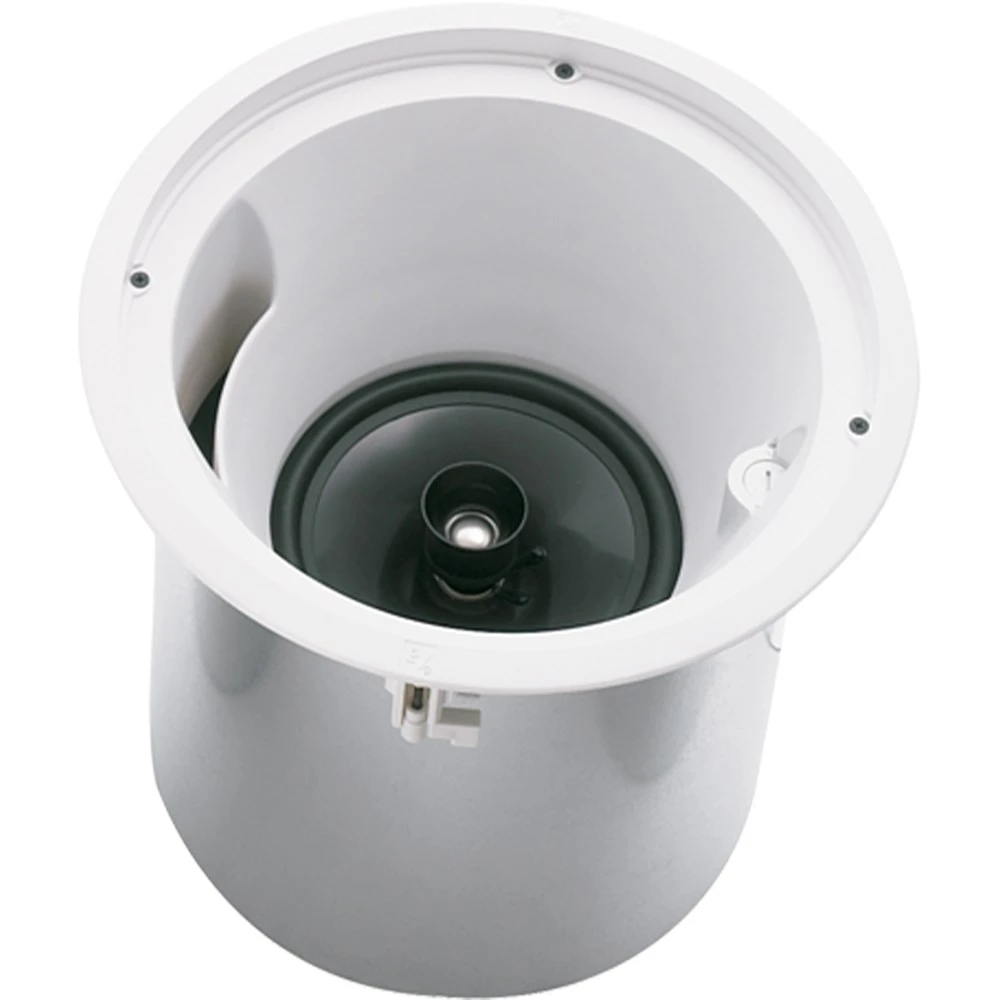
Let's start at the very beginning. A ceiling speaker is a loudspeaker designed to be mounted flush into the ceiling of a room, so that only the grille is visible from below. The main body of the speaker sits hidden in the cavity above the ceiling tiles or plasterboard.
The goal of a ceiling speaker system isn't to blast loud music at a crowd (that's what the big speakers on stands at a concert are for). Instead, it's to spread sound evenly and gently across an entire space. Think background music in a restaurant, announcements in a shopping centre, or clear paging in an office. This is often called distributed audio — the sound is "distributed" across many small speakers rather than coming from one loud point.
New to this? Here's a helpful analogy. Imagine trying to light a room. You could use one very bright spotlight in the corner (that's like a single big speaker — loud near it, dark far away), or you could use several soft downlights spread across the ceiling for even, comfortable lighting everywhere. Ceiling speakers are the audio version of those downlights.
Decoding the Name: What Does "EViD C8.2HC" Actually Mean?
Product names in pro audio can look like a random string of letters and numbers, but they usually tell you something useful. Let's break this one down:
- EViD — Electro-Voice's brand name for their Engineered Voice Installation Design range, purpose-built for permanent installations in commercial spaces.
- C — stands for Ceiling. (Electro-Voice also make an "S" range for surface-mount speakers that hang on walls.)
- 8 — the size of the main woofer in inches. An 8-inch driver is on the larger side for a ceiling speaker, which means it moves more air and produces fuller, deeper sound.
- .2 — indicates it's a 2-way speaker (more on what that means below).
- HC — stands for High Ceiling or enhanced pattern control, designed for rooms with taller ceilings where sound needs to travel further down without spreading too wide.
So in plain English: this is an 8-inch, two-way ceiling speaker from Electro-Voice's professional installation range, engineered specifically for rooms with high ceilings.
Understanding the Key Features (Without the Jargon)
"2-Way" and "Coaxial" — What They Mean and Why They Matter
You'll see the words 2-way coaxial attached to this speaker. Here's what that's all about.
Sound covers a huge range of frequencies, from deep bass rumbles to sparkly high treble. It's very hard for a single speaker cone to reproduce all of that well. So a 2-way speaker splits the work between two dedicated drivers:
- A larger woofer handles the low and mid frequencies (voices, warmth, body).
- A smaller tweeter handles the high frequencies (clarity, detail, crispness).
Coaxial means these two drivers are mounted on the same axis — the tweeter sits right in the centre of the woofer, rather than beside it. Why does this matter? Because it makes the speaker behave like a single, unified sound source. The result is that music and voices sound natural and coherent no matter where you're standing underneath. For a beginner, this is one of the most important quality markers to look for.
Enhanced Pattern Control — The "HC" Advantage
This is the feature that really sets the C8.2HC apart, so it's worth understanding. Pattern control refers to how tightly a speaker focuses its sound in a particular direction, like a torch beam versus a bare lightbulb.
In a room with a normal-height ceiling, sound doesn't have far to travel, so a wide spread works fine. But in spaces with high ceilings — think warehouses, atriums, churches, gyms, or double-height retail spaces — a regular speaker's sound spreads out too much by the time it reaches people's ears. This causes two problems: the sound gets weaker, and it can bounce off walls creating echo and muddiness.
The enhanced pattern control in the C8.2HC uses a specially designed waveguide (the shaped surface around the tweeter) to keep the high frequencies focused in a tighter, more controlled beam pointing downward. This means clearer speech and music reaching listeners even from a tall ceiling, with less wasted energy and less echo. If your space has high ceilings, this feature alone is a compelling reason to choose this model.
Built for Real-World Installation
Electro-Voice designed the EViD range to make installers' lives easier and to survive years of continuous use. Practical features typically include:
- A tile-bridge or support system so the speaker sits securely in suspended ceilings.
- A built-in transformer with tap settings for connecting to 70V or 100V systems (we'll explain these shortly).
- A robust grille and enclosure that resists dust and handles ongoing commercial use.
The One Concept Every Beginner Must Understand: 70V/100V Systems
This is the single most important thing that trips up newcomers, so let's cover it carefully.
When you have just a couple of speakers, you wire them directly to an amplifier — this is called a low-impedance (or 8-ohm) connection, and it's what home hi-fi uses. But in a commercial space you might have dozens of ceiling speakers spread across a large area. Wiring all of those directly would be a nightmare and would overload the amplifier.
The solution is a constant-voltage system, known in Australia as a 100V line system (you'll also see 70V used in some designs). Here's the simple version:
- Each speaker has a small transformer with selectable power taps (for example 7.5W, 15W, 30W).
- You choose how much power each speaker draws by picking a tap.
- This lets you connect many speakers to one amplifier on a single cable run, and easily balance the volume across the whole system.
Beginner tip: When planning a system, add up the wattage taps of all your speakers, then choose an amplifier that comfortably exceeds that total (leaving around 20% headroom). The C8.2HC supports these tap settings, making it ready to drop into a professional 100V installation. It can also run in standard 8-ohm low-impedance mode for smaller setups.
A Beginner's Buying Guide: What Should You Prioritise?
Feeling ready to make a decision? Here's how to think about it as a first-time buyer.
1. Match the Speaker to Your Ceiling Height
This is the golden rule. If your ceilings are standard height (around 2.4–3 metres), a regular ceiling speaker will serve you well. But if you're working with tall ceilings, the enhanced pattern control of the C8.2HC is designed exactly for you. Buying a high-ceiling speaker for a low room is overkill; buying a standard speaker for a high room leads to disappointing, echoey sound.
2. Think About Coverage and Speaker Count
A common beginner mistake is buying too few speakers and cranking them loud to compensate. This creates hot and cold spots — deafening under the speaker, faint between them. Instead, use more speakers at gentle levels for even, comfortable coverage. An 8-inch model like this covers more area per unit than smaller 4- or 6-inch speakers, which can reduce the total number you need in the right room.
3. Don't Skimp on the Amplifier and Cabling
Great speakers fed by an underpowered or cheap amplifier will disappoint. Budget for a quality 100V-capable amplifier and appropriately rated cable. Think of the whole system as a chain — it's only as good as its weakest link.
4. Consider Where You'll Grow
A benefit of choosing a professional range like EViD is consistency. You can start with a handful of speakers and expand later, mixing in other EViD models (such as ceiling subwoofers for extra bass, or surface-mount speakers for walls) that are voiced to work together. This growth path is much smoother than mixing random brands.
Common Beginner Questions, Answered
Can I install these myself?
Simple, single-room low-impedance setups can be a DIY-friendly project for the confident. However, anything involving 100V line systems, multiple rooms, or fixed wiring in a commercial building often requires a licensed electrician or professional installer in Australia — both for safety and to meet regulations. When in doubt, get a professional to at least sign off on the plan.
Are these good for music, or just announcements?
Both. Because it's a genuine 2-way coaxial design with an 8-inch woofer, the C8.2HC reproduces music with real warmth and clarity — not just tinny speech. That makes it well suited to venues where background music quality actually matters, like cafes, restaurants, boutiques and hotels, as well as clear paging and announcements.
How many will I need?
It depends entirely on your room's size, shape and ceiling height. As a rough starting point, an 8-inch high-output ceiling speaker covers a generous area, but the only reliable way to plan is a proper coverage calculation. This is exactly the kind of thing the team at a specialist retailer can help you work out.
Where does the C8.2HC fit best?
Its high-ceiling focus makes it ideal for larger, taller spaces: shopping centres, gymnasiums, houses of worship, transport hubs, warehouses, showrooms and open-plan hospitality venues with elevated ceilings.
View the Electro-Voice EViD C8.2HC on MusiconStage
Honest Pros and Cons for First-Time Buyers
No product is perfect for every situation, so here's a balanced view.
Strengths:
- Enhanced pattern control genuinely solves the high-ceiling problem that defeats ordinary speakers.
- Coaxial 2-way design delivers coherent, natural sound quality good enough for music, not just paging.
- Backed by Electro-Voice's long-standing reputation for reliable, professional-grade installation gear.
- Flexible 100V/8-ohm operation suits both large distributed systems and smaller setups.
Things to keep in mind:
- If your ceilings are standard height, you may not need the "HC" high-ceiling features — a standard EViD model could be more cost-effective.
- Like all quality install speakers, it's an investment that pays off best when paired with a proper amplifier and thoughtful design.
- Full commercial installations usually benefit from professional planning rather than a pure DIY approach.
Getting Started: Your Next Steps
You've now covered the essentials — what ceiling speakers are, how coaxial 2-way designs work, why pattern control matters for high ceilings, and how 100V systems let you scale up. That's more than enough to have a confident, informed conversation about your project.
Here's a simple roadmap from here:
- Measure your space — note the ceiling height, room dimensions and what you'll use the audio for.
- Decide standard vs high-ceiling — this points you to the right model in the range.
- Plan the system — speaker count, amplifier and cabling, ideally with expert input.
- Buy from a specialist who can offer advice, warranty support and the right matching components.
The great thing about learning the fundamentals is that you're no longer at the mercy of guesswork or a pushy salesperson — you understand why a speaker like the C8.2HC exists and when it's the right tool for the job. That confidence is exactly what leads to a system you'll be happy with for years.
Check availability and pricing for the EViD C8.2HC at MusiconStage
If you have questions specific to your venue, don't hesitate to reach out to a knowledgeable Australian retailer — a quick chat about your ceiling height and room size can save you time, money and the frustration of a system that doesn't quite hit the mark. Happy listening!