
Audio-Technica ATH-M70x: Professional Monitor Headphones Deep Dive 2026
Audio-Technica ATH-M70x Professional Monitor Headphones: Complete Technical Breakdown 2026
If you've spent any time around professional studios, broadcast rooms, or mastering suites, you've probably noticed Audio-Technica's M-Series headphones on more than a few heads. The ATH-M50x became something of an industry standard — the default recommendation when anyone asked for "good studio headphones." But the ATH-M70x? That's a different beast entirely, and one that doesn't get nearly the attention it deserves from serious audio professionals here in Australia.
The M70x sits at the top of Audio-Technica's professional monitoring lineup, and it was designed with a fundamentally different philosophy than its more famous sibling. Where the M50x flatters, the M70x reveals. Where the M50x compromises for broad appeal, the M70x commits fully to accuracy. Let's pull apart the specifications and figure out exactly what that means for your work.
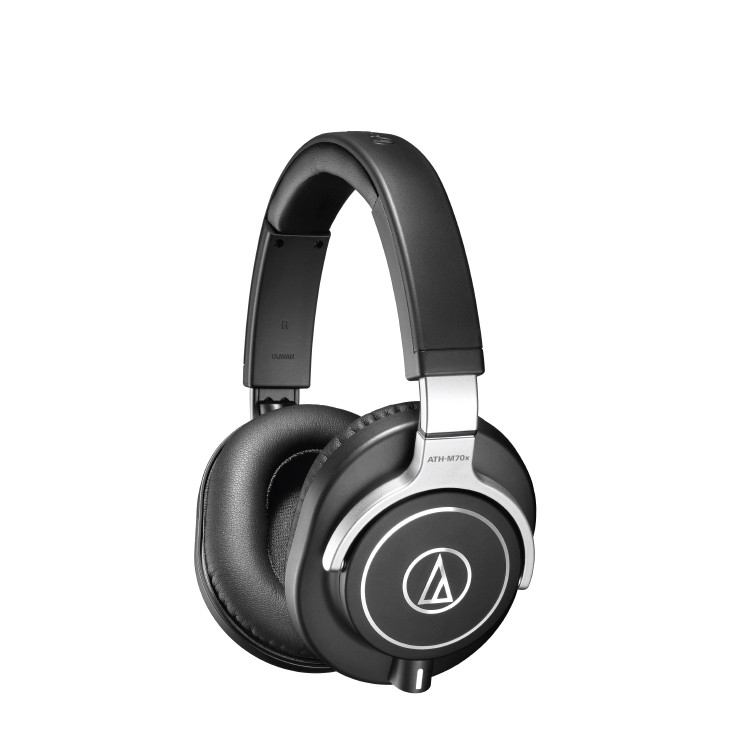
Technical Specifications: What the Numbers Actually Tell You
Before we interpret anything, here are the raw specifications. If you're the type who reads spec sheets before product descriptions (and if you're considering the M70x, you probably are), this table gives you everything up front.
| Specification | ATH-M70x | Context |
|---|---|---|
| Driver Diameter | 45mm | Large-format dynamic driver |
| Frequency Response | 5 Hz – 40,000 Hz | Extended range both ends |
| Impedance | 35 ohms | Easy to drive from most sources |
| Sensitivity | 97 dB/mW | Lower than typical — deliberate design choice |
| Maximum Input Power | 2,000 mW | Exceptional headroom |
| Type | Closed-back, circumaural | Isolation-focused over-ear design |
| Weight | 280g (without cable) | Moderate — lighter than many competitors |
| Cable | Detachable, 3x included | 1.2m straight, 1.2m coiled, 3.0m straight |
| Connector | 3.5mm with 6.3mm adapter | A2DC proprietary locking connector at headphone end |
Frequency Response: The 5 Hz – 40 kHz Story
That frequency response figure — 5 Hz to 40 kHz — looks impressive on paper, but let's talk about what it actually means in practice. Human hearing tops out around 20 kHz (and realistically, if you've been working in audio for years, your upper limit is probably closer to 15–16 kHz). So why does the extended range matter?
The answer lies in transient response. Drivers capable of reproducing frequencies well beyond the audible range tend to handle fast transients within the audible spectrum more accurately. The ultra-low extension down to 5 Hz means the driver can reproduce sub-bass content without the mechanical strain that causes distortion in less capable drivers. You won't "hear" 5 Hz, but you'll notice cleaner bass reproduction at 30–60 Hz because the driver isn't being pushed to its limits.
Audio-Technica achieves this with their proprietary 45mm large-aperture drivers, which use a copper-clad aluminium wire voice coil. The copper cladding provides excellent conductivity while the aluminium core keeps mass low — a critical factor for transient accuracy. This is a genuine engineering choice, not marketing fluff.
Sensitivity and Impedance: Why 97 dB Matters
Here's where the M70x gets interesting, and where many buyers get confused. At 97 dB/mW sensitivity, the M70x is notably less sensitive than the M50x (99 dB) and significantly less sensitive than many consumer headphones that sit around 105–110 dB. Combined with the 35-ohm impedance, you might wonder if they'll be loud enough from a phone or laptop.
The short answer: yes, they'll work from portable sources, but they won't shine. The M70x was designed with the assumption that you're running them from a proper headphone amplifier or a professional audio interface — gear like an Audient iD4, RME Babyface, or Universal Audio Apollo. From these sources, the lower sensitivity actually becomes an advantage: you get more usable range on your volume control, and you're less likely to encounter noise floor issues from the amplification chain.
The 2,000 mW maximum input power is worth noting too. That's an enormous amount of headroom, meaning these headphones can handle serious peak levels without distortion — exactly what you need when monitoring percussion-heavy material or checking mixes at elevated levels.
Sound Signature and Monitoring Accuracy
This is where the M70x truly separates itself from the pack. Audio-Technica describes the tuning as "accurate" and "flat," but let's be more specific about what that means in practice.
Bass Response
The low end on the M70x is tight, controlled, and extended — but not boosted. If you're coming from the M50x or consumer headphones, your first impression might be that the bass is "missing." It isn't. What's missing is the gentle low-end emphasis that makes music sound more impressive but less accurate. The M70x shows you exactly what's in your mix, which means if your bass sounds thin on these, it probably is thin.
For mixing and mastering work, this is invaluable. You can trust the low-end representation to translate accurately to other systems. The sub-bass extension means you'll catch problematic rumble, DC offset issues, or excessive low-frequency content that less capable headphones simply can't reproduce.
Midrange Character
The midrange is where the M70x earns its "professional monitor" designation. Vocals, guitars, keyboards — everything in the critical 500 Hz to 5 kHz range is presented with exceptional clarity and minimal coloration. There's a very slight presence lift in the upper midrange that helps with detail retrieval without creating harshness. This is particularly useful for identifying sibilance issues, nasal vocal qualities, or mid-frequency masking problems that can be difficult to catch on speakers in an untreated room.
Treble and Detail
The high-frequency presentation is detailed and extended but not fatiguing — a balance that's genuinely difficult to achieve in a closed-back design. Audio-Technica's driver technology delivers clean treble without the metallic or grainy quality that plagues many competitors at this price point. You'll hear reverb tails, breath noise, and high-frequency artefacts clearly, which is exactly what you want when you're making critical mixing decisions.
Build Quality and Materials Analysis
The M70x is built to survive professional use, but it takes a different approach to durability compared to the M50x. The overall construction uses a combination of metal and high-quality synthetic materials, with particular attention paid to the headband mechanism and swivel joints — the two points where most headphones eventually fail.
Headband and Comfort
The headband uses a metal internal structure with generous padding. Clamping force is moderate — firm enough for good isolation but not so tight that extended sessions become uncomfortable. At 280 grams without the cable, the M70x sits in a comfortable weight range for long mixing sessions. The circumaural (over-ear) design means the ear pads fully surround your ears rather than sitting on them, which reduces fatigue during those marathon sessions that Aussie studio life inevitably demands.
The ear pads themselves are a professional-grade synthetic leather. They provide good isolation — roughly 15–20 dB of passive noise reduction depending on fit — and are replaceable, which matters enormously for a professional tool. Ear pads are consumable items; they wear out, and being able to replace them extends the usable life of the headphones by years.
The Detachable Cable System
Audio-Technica uses their proprietary A2DC (Audio Designed Detachable Coaxial) connector for the headphone-end cable connection. This is a locking bayonet-style connector that provides a more secure and acoustically superior connection compared to standard 3.5mm or twist-lock connectors.
The inclusion of three cables — a 1.2m straight cable for portable use, a 1.2m coiled cable for studio work near your desk, and a 3.0m straight cable for when you need to move around — covers virtually every professional scenario. The coiled cable, in particular, is a thoughtful inclusion: it stays tidy at your workstation but extends when you reach for that outboard compressor or lean back in your chair.
If you need a custom-length cable or a balanced connection for high-end headphone amps, third-party A2DC cables are available, though the selection is more limited than for standard connectors.
ATH-M70x vs the Competition: Technical Comparison
Understanding where the M70x sits relative to its competitors helps clarify who should buy it and who might be better served elsewhere.
| Feature | ATH-M70x | ATH-M50x | Beyerdynamic DT 770 Pro | Sennheiser HD 280 Pro |
|---|---|---|---|---|
| Frequency Response | 5–40,000 Hz | 15–28,000 Hz | 5–35,000 Hz | 8–25,000 Hz |
| Impedance | 35Ω | 38Ω | 80Ω (studio version) | 64Ω |
| Sensitivity | 97 dB/mW | 99 dB/mW | 96 dB/mW | 113 dB (1V/1kHz) |
| Driver Size | 45mm | 45mm | 45mm | 40mm |
| Weight | 280g | 285g | 270g | 240g |
| Detachable Cable | Yes (3 included) | Yes (3 included) | No | No |
| Sound Character | Flat/analytical | Slightly enhanced bass | V-shaped (fun) | Neutral with rolled treble |
| Best For | Mixing, mastering, critical listening | Tracking, general studio use | Tracking, enjoyable monitoring | Budget monitoring, broadcast |
M70x vs M50x: The Key Differences
This is the comparison most people ask about, and it's important to understand that these are fundamentally different tools despite sharing a family name. The M50x has a gently enhanced low-end and a slight treble sparkle that makes music sound engaging and dynamic. It's an excellent headphone for tracking musicians (because it sounds good and keeps performers inspired) and for general studio use.
The M70x strips away that flattery. Its frequency response is genuinely flatter, with better extension at both ends of the spectrum. The imaging and stereo separation are noticeably improved — you can place instruments in the stereo field more precisely, and you'll catch panning and spatial effects that the M50x blurs together slightly. For mixing decisions, mastering work, or quality control, the M70x provides information the M50x simply doesn't.
Think of it this way: the M50x tells you your mix sounds good. The M70x tells you whether your mix actually is good.
M70x vs Beyerdynamic DT 770 Pro
The DT 770 Pro is a studio staple, particularly for tracking, and it's a brilliant headphone for that purpose. However, its V-shaped frequency response — boosted bass and treble with a slightly recessed midrange — makes it less suitable for critical mixing work. The DT 770's fixed cable is also a drawback in professional environments where cables inevitably get damaged. The M70x wins decisively for accuracy and practicality, though the DT 770 remains arguably more comfortable for very long sessions thanks to its velour pad options.
Who Should Buy the ATH-M70x (And Who Shouldn't)
Ideal Users
- Mixing engineers who need a reliable headphone reference that translates well to speakers and real-world playback systems
- Mastering engineers who require the highest level of detail retrieval and frequency accuracy from a closed-back design
- Broadcast and post-production professionals who need to catch subtle audio issues in dialogue, effects, and music beds
- Quality control engineers at pressing plants, streaming services, or content delivery platforms
- Serious home studio operators in Australia who work in untreated or poorly treated rooms and rely heavily on headphone monitoring
Who Might Be Better Served Elsewhere
- Casual listeners who want headphones that make music sound exciting — the M70x's flat response can sound "boring" if you're used to consumer tuning
- Musicians tracking in the studio — the M50x or DT 770 will likely provide a more inspiring monitoring experience during performance
- Buyers seeking wireless convenience — the M70x is a wired-only, studio-first tool
- Budget-conscious beginners — if you haven't developed critical listening skills yet, you won't fully benefit from what the M70x offers over the M50x
Real-World Usage Considerations for Australian Studios
A few practical points worth mentioning for Australian buyers specifically:
Climate considerations: Australia's warmer climate means closed-back headphones can get uncomfortable during summer sessions. The M70x's moderate clamping force and relatively lightweight design help, but extended sessions in un-air-conditioned spaces will still get warm. Keep spare ear pads on hand — sweat accelerates pad degradation.
Source gear matters: If you're running these from a Focusrite Scarlett Solo or similar entry-level interface, you'll get sound out of them, but you won't hear what they're truly capable of. Budget at least a mid-range interface or a dedicated headphone amp to unlock the M70x's full potential. Australian retailers stock excellent options from Audient, MOTU, and RME that pair beautifully with these headphones.
The headphone mixing caveat: Even with headphones as accurate as the M70x, mixing exclusively on headphones has inherent limitations — primarily around low-frequency perception and stereo field representation. Crossfeed plugins (like Goodhertz CanOpener or Waves NX) can help simulate speaker-like presentation. Use the M70x as a primary reference alongside even modest nearfield monitors for the best results.
Ready to hear what's actually in your mixes? Check the current price of the ATH-M70x at MusiconStage — they ship Australia-wide with local warranty support.
Technical Deep Dive: The 45mm Driver Design
Audio-Technica's 45mm driver in the M70x deserves a closer look, because it's not simply a repurposed M50x driver with different tuning. The M70x uses a purpose-built driver with a different diaphragm geometry and magnet structure optimised for flat response rather than the M50x's more consumer-friendly signature.
The copper-clad aluminium wire (CCAW) voice coil is a technology Audio-Technica has refined over decades. Pure copper wire would provide marginally better conductivity, but at significantly higher mass. The aluminium core reduces moving mass, which directly improves transient response — the driver's ability to start and stop quickly in response to the signal. This is why the M70x sounds "fast" and precise on percussive material, and why reverb tails and room ambience are so clearly rendered.
The neodymium magnet assembly provides the strong, consistent magnetic field needed to control a low-mass voice coil precisely. This combination — strong magnets, light coil, carefully tuned diaphragm — is what enables the extended frequency response without the resonance peaks and dips that plague less carefully engineered drivers.
Specifications That Actually Matter for Purchase Decisions
When evaluating the M70x against competitors, focus on these specifications rather than headline numbers:
- Frequency response flatness — not just the range, but how even the response is within the audible band. The M70x excels here.
- Distortion at rated power — the M70x's 2,000 mW maximum input with clean reproduction means you can monitor at professional levels without distortion creeping in.
- Impedance consistency across frequency — a flat impedance curve means consistent performance regardless of what amplifier you're using. The 35-ohm nominal impedance with minimal variation makes the M70x predictable and reliable across different source gear.
- Isolation performance — the closed-back design provides meaningful passive isolation, reducing the need for extreme monitoring levels and protecting your hearing during long sessions.
- Weight and clamping force balance — at 280g, the M70x is light enough for multi-hour sessions without neck fatigue, with enough clamping force to maintain seal and isolation.
Frequently Asked Technical Questions
Can I use the M70x for mixing without monitors?
You can, and many professionals do — particularly in home studios with poor acoustics. The M70x is one of the best closed-back options for this purpose. However, use a crossfeed plugin to compensate for the inherent limitations of headphone monitoring, and reference your mixes on other systems (car stereo, earbuds, Bluetooth speaker) before finalising.
Do I need a headphone amp?
Not strictly, but a quality headphone output (from a proper audio interface or dedicated amp) will deliver noticeably better performance than a laptop headphone jack. The M70x is revealing enough that source quality matters.
How do the M70x compare to open-back headphones for mixing?
Open-back designs like the Sennheiser HD 600 or AKG K712 Pro generally offer a more natural soundstage and are preferred by many mixing engineers. The M70x's advantage is isolation — if you're working in a noisy environment, sharing a room, or need to monitor without sound leakage, the M70x is the professional closed-back answer. Its imaging and accuracy approach open-back performance, which is a genuine engineering achievement.
Are replacement parts available in Australia?
Yes. Ear pads, headband padding, and cables are all replaceable and available through Australian Audio-Technica distributors. The A2DC cable system means third-party cable options exist as well, though the stock cables are of excellent quality.
The Verdict: Precision That Professional Work Demands
The Audio-Technica ATH-M70x isn't trying to be everything to everyone, and that's precisely why it succeeds at what it does. This is a purpose-built professional monitoring tool designed for critical listening, accurate mixing, and detail-oriented audio work. Its flat, extended frequency response reveals the truth in your recordings — for better or worse — and its build quality ensures it'll keep doing so for years of professional use.
If you're an Australian audio professional who has outgrown the M50x, or if you're serious about headphone-based mixing and need a closed-back reference you can genuinely trust, the M70x delivers at a price point that's remarkably fair for its capability level. It's not the most exciting headphone you'll ever put on. But it might be the most honest.
Order the Audio-Technica ATH-M70x from MusiconStage with Australia-wide shipping and full local warranty. For questions about pairing the M70x with the right interface or amp for your setup, their team can point you in the right direction.