
Audio Technica ATH-M70x Explained: Beginner's Guide to Pro Monitoring 2026
Audio Technica ATH-M70x Explained: A Beginner's Guide to Professional Monitoring Headphones in 2026
If you've been reading about studio headphones and keep seeing the Audio Technica ATH-M70x mentioned alongside words like "reference" and "critical listening," you're probably wondering what all the fuss is about — and whether these are the right headphones for you.
Don't worry. We're going to break everything down in plain language. By the end of this guide, you'll understand exactly what professional monitor headphones are, why the ATH-M70x sits at the top of Audio Technica's acclaimed M-Series, and whether they're the right investment for your ears and your goals.
What Are Professional Monitor Headphones? (And Why Should You Care?)
Before we dive into the M70x specifically, let's start with the basics. If you're new to audio, the term "monitor headphones" might sound like something you'd plug into a computer screen. Not quite.
Monitor headphones are designed to reproduce sound as accurately and honestly as possible. Think of them as a magnifying glass for audio. While consumer headphones often boost the bass or tweak the treble to make music sound more exciting, monitor headphones aim to show you exactly what's in the recording — nothing added, nothing taken away.
Here's a helpful analogy: imagine you're editing a photograph. You wouldn't want a screen that automatically adds a warm filter to everything — you'd want a screen that shows true colours. That's exactly what monitor headphones do for sound.
Who Uses Monitor Headphones?
- Music producers and engineers — to hear exactly what they're mixing
- Mastering engineers — to make final, precise adjustments to recordings
- Podcasters and voice-over artists — to catch imperfections in vocal recordings
- DJs — to accurately cue and beat-match tracks
- Audiophiles — people who simply want to hear music the way the artist intended
- Video editors and content creators — to ensure audio matches professional standards
Understanding Audio Technica's M-Series: Where Does the M70x Fit?
Audio Technica's M-Series is one of the most respected lines of professional headphones in the world. You've probably come across the famous ATH-M50x — it's practically the default recommendation for anyone entering the audio world. But the M-Series is actually a full family, and understanding the lineup helps you see why the M70x exists.
The M-Series Family, Simplified
- ATH-M20x — Entry level. Great for casual monitoring and practice.
- ATH-M30x — Step up with better clarity and detail retrieval.
- ATH-M40x — Flat, neutral response beloved by mixing engineers on a budget.
- ATH-M50x — The famous all-rounder. Slightly enhanced low end, excellent detail. The one everyone knows.
- ATH-M70x — The flagship. The most accurate, most revealing, most uncompromising headphone in the range.
Think of it like this: if the M50x is the reliable family car that does everything well, the M70x is the precision instrument — purpose-built for professionals who need to hear every last detail in a recording. It's not trying to make music sound "nice." It's trying to make music sound true.
What Makes the ATH-M70x Special? Key Features Explained Simply
Let's go through the features that define the M70x, and more importantly, explain why each one matters in language that doesn't require an audio engineering degree.
1. Extended Frequency Response (5 Hz – 40,000 Hz)
What this means: Frequency response tells you the range of sounds a headphone can reproduce, measured in Hertz (Hz). Human hearing typically ranges from about 20 Hz (deep bass rumbles) to 20,000 Hz (the highest treble).
The M70x goes well beyond that range in both directions — down to 5 Hz and up to 40,000 Hz. Why does that matter if you can't consciously hear those extremes? Because those ultra-low and ultra-high frequencies influence the feel and texture of the sounds you can hear. Sub-bass frequencies add a sense of physical depth, while extended treble contributes to airiness and realism.
Why it matters for you: You'll hear more nuance, more detail, and more "reality" in music compared to headphones with a narrower range.
2. 45mm Large Aperture Drivers with Rare Earth Magnets
What this means: The "driver" is the little speaker inside each ear cup that actually creates the sound. At 45mm, the M70x uses a generously sized driver — larger drivers generally move more air and produce fuller, more detailed sound.
The "rare earth magnets" part refers to the type of magnet used in the driver. These magnets are stronger and more precise than standard ferrite magnets, which means the driver responds more quickly and accurately to the audio signal.
Why it matters for you: Tighter, more controlled bass. Cleaner transients (the initial attack of a drum hit or guitar strum). More detail without harshness.
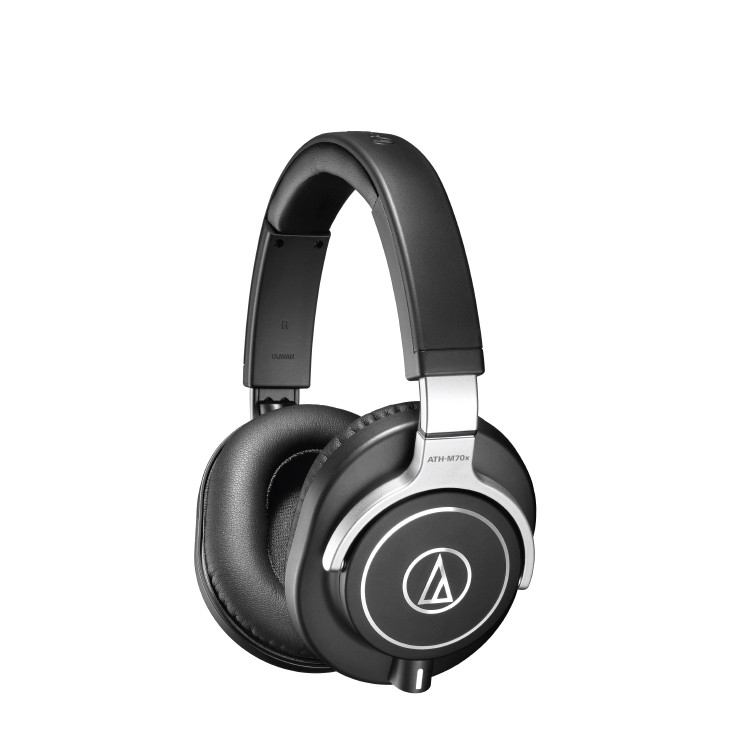
3. Circumaural (Over-Ear), Closed-Back Design
Two important terms here:
- Circumaural means the ear pads go completely around your ears rather than sitting on top of them. This is more comfortable for extended use and creates a better seal.
- Closed-back means the ear cups are sealed, preventing sound from leaking in or out. This isolates you from your environment and keeps your listening private.
Why it matters for you: You can monitor in noisy environments (like a live venue or a shared studio) without outside sounds interfering. It also means the person sitting next to you won't hear your mix bleeding out of the headphones.
4. Detachable Cable System with Three Included Cables
The M70x comes with three different cables, and they all connect via a locking twist mechanism at the left ear cup:
- 1.2m straight cable — Perfect for portable use and short-distance monitoring
- 3.0m straight cable — Ideal for studio work where you need to move around
- 1.2m–3.0m coiled cable — The classic DJ/studio cable that stretches when you need it and retracts when you don't
Why it matters for you: First, if a cable breaks, you replace the cable — not the entire headphone. That alone extends the lifespan enormously. Second, different situations call for different cables, and having all three included means you're covered straight out of the box.
5. Professional-Grade Build Quality
The M70x is built to withstand daily professional use. The headband features robust construction with a reliable swivel mechanism that allows the ear cups to fold flat for transport. The ear pads are replaceable (they will wear over time with heavy use, and being able to swap them out is a genuine long-term advantage).
Why it matters for you: These are built to last years, not months. In professional audio, gear gets thrown in bags, used for 8-hour sessions, and generally put through its paces. The M70x is designed for exactly that life.
6. 35 Ohm Impedance
What this means: Impedance (measured in ohms) tells you how much power the headphones need to reach a proper listening volume. At 35 ohms, the M70x is relatively easy to drive. You won't necessarily need a dedicated headphone amplifier, though one can still improve performance.
Why it matters for you: You can plug these directly into a laptop, audio interface, mixing console, or smartphone and get solid volume levels. Some high-end headphones require 250 or even 600 ohms and absolutely need an amplifier — the M70x doesn't have that barrier to entry.
The M70x Sound: What to Actually Expect
This is where beginners often get confused, so let's be really honest about what "professional monitoring" headphones sound like compared to what you might be used to.
They Won't Sound "Better" at First — They'll Sound Different
If you're coming from consumer headphones (Beats, Sony WH-series for casual listening, etc.), your first reaction to the M70x might be: "Where did the bass go?" or "These sound kind of... flat."
That's actually exactly the point. The M70x isn't adding extra bass to make hip-hop hit harder, and it's not boosting the treble to make pop vocals sparkle artificially. It's showing you the actual mix.
After a few days of listening, something remarkable happens: you start hearing things you never noticed before. The subtle reverb tail on a vocal. The ghost notes a drummer is playing. The room tone in a podcast recording. A tiny bit of distortion in a synth layer that you never knew was there.
That's what professionals are paying for — the ability to hear everything.
The M70x Sound Profile
- Bass: Tight, controlled, and extended. It's there when the recording has it, but it won't be artificially inflated. If you're listening to a well-produced track, the bass on the M70x is genuinely satisfying — just accurate rather than bloated.
- Midrange: Exceptionally clear and detailed. Vocals, guitars, and pianos sound natural and present. This is where the M70x truly shines.
- Treble: Extended and revealing. You'll hear cymbals shimmer with realistic detail, and high-frequency elements are crisp without being fatiguing. Some listeners find the treble slightly forward compared to the M50x — this is by design, as it helps engineers spot issues in the high end.
- Soundstage: For a closed-back headphone, the M70x has respectable imaging and separation. You can pick out individual instruments in a busy mix with relative ease.
ATH-M70x vs ATH-M50x: The Question Every Beginner Asks
This is probably the most common comparison people search for, so let's address it directly.
| Feature | ATH-M50x | ATH-M70x |
|---|---|---|
| Sound signature | Slightly enhanced bass, engaging | Flat, accurate, analytical |
| Frequency response | 15 Hz – 28,000 Hz | 5 Hz – 40,000 Hz |
| Best for | All-round monitoring, casual listening | Critical listening, mastering, detail work |
| Forgiving? | Yes — makes most music sound good | No — reveals flaws honestly |
| Included cables | 3 cables | 3 cables |
The honest take: If you're just getting started with music production and want something that's both a great monitoring tool and enjoyable for everyday listening, the M50x is the safer choice. If you're specifically after accuracy — if you're mixing, mastering, or doing work where hearing every flaw matters — the M70x is the better tool for the job.
Many professionals actually own both: the M50x for tracking and general listening, and the M70x for critical evaluation and final checks.
Who Should Buy the ATH-M70x? (And Who Shouldn't)
The M70x Is a Great Choice If You:
- Are mixing or mastering music and need a reliable reference point
- Work in audio post-production for film, video, or podcasts
- Want headphones that reveal problems in recordings so you can fix them
- Are an audiophile who values accuracy above all else
- Need a durable, professional-grade headphone that will last for years
- Already own consumer headphones and want to step into the professional world
You Might Want to Consider Alternatives If You:
- Primarily want headphones for casual music enjoyment (the M50x will likely be more satisfying)
- Prefer a bass-heavy sound signature (the M70x won't give you that)
- Are on a tight budget and this is your first-ever pair of decent headphones (start with the M40x or M50x and work your way up)
- Want wireless convenience (the M70x is wired only, as professional monitoring requires the reliability and zero-latency of a wired connection)
Beginner Mistakes to Avoid When Buying Monitor Headphones
If you're new to this world, here are some common traps that catch first-time buyers:
- Judging monitor headphones in the first five minutes. Your ears need time to adjust to an accurate sound signature. Give it at least a week of regular listening before forming a final opinion. This is genuinely important advice that many experienced audio professionals will echo.
- Thinking more expensive always means "better sounding." "Better" in professional audio means "more accurate" — not "more bass" or "more exciting." The M70x costs more than the M50x because it's more precise, not because it sounds more fun.
- Ignoring comfort for long sessions. If you're going to wear headphones for hours at a time, comfort matters enormously. The M70x's circumaural design and padded headband are built for extended wear, but everyone's head shape is different. Make sure you can try them or buy from a retailer with a good return policy.
- Cranking the volume to hear details. Monitor headphones reveal detail at moderate volumes. If you're turning everything up to hear what's going on, you're damaging your hearing and defeating the purpose. The M70x is designed to deliver clarity at safe listening levels.
- Expecting them to replace studio monitors. Headphones and studio monitor speakers serve different purposes. Ideally, you'd use both as part of your monitoring chain. Headphones are great for detail work and late-night sessions; speakers give you a better sense of how sound behaves in a physical space.
What's in the Box?
When you open your ATH-M70x, here's what you'll find:
- ATH-M70x headphones
- 1.2m straight cable
- 3.0m straight cable
- 1.2m–3.0m coiled cable
- 6.3mm (1/4") screw-on adapter (essential for plugging into mixing desks and audio interfaces)
- Protective carrying pouch
Everything you need to get started is included. No extra purchases required on day one.
Getting Started: What to Expect in Your First Week
Bought a pair? Brilliant. Here's what the first week typically looks like:
Day 1–2: Things might sound "different" from what you're used to. The bass might seem lighter, the treble more present. This is normal. You're hearing accuracy for the first time.
Day 3–5: Your ears start adjusting. You'll begin noticing details in familiar songs you've never heard before. A backing vocal you missed. The texture of a snare drum. The space around instruments.
Day 6–7: Going back to your old headphones will feel like looking at a photo through a foggy window. The M70x has recalibrated your expectations for what music can sound like.
This adjustment period is completely normal and happens with any step up to professional-grade monitoring equipment. Stick with it.
Quick Specs Reference
- Type: Closed-back, dynamic
- Driver: 45mm with rare earth magnets
- Frequency Response: 5 Hz – 40,000 Hz
- Impedance: 35 ohms
- Sensitivity: 97 dB/mW
- Max Input Power: 2,000 mW
- Weight: Approximately 280g (without cable)
- Cable: Detachable, locking twist connector (3 cables included)
- Connector: 3.5mm with included 6.3mm adapter
Frequently Asked Questions from Beginners
Do I need a headphone amplifier for the M70x?
Not necessarily. At 35 ohms, the M70x can be driven by most devices. However, a quality headphone amp or audio interface will get the best performance out of them — cleaner power means cleaner sound. If you're plugging into a professional audio interface or mixing console, you're already sorted.
Can I use these for everyday music listening?
Absolutely. Many people use the M70x as their primary listening headphones. Just be aware that the flat, accurate sound signature means poorly produced music will sound... poorly produced. On the flip side, well-recorded music sounds absolutely stunning.
Are these comfortable for long sessions?
The M70x is designed for professional use, which means extended sessions. The circumaural pads distribute pressure around your ears rather than on them, and the headband provides even clamping force. Most users find them comfortable for several hours at a stretch. The 280g weight keeps fatigue low.
How do these compare to open-back headphones?
Open-back headphones (like the Audio Technica ATH-R70x) typically offer a wider soundstage and more natural sound, but they leak sound in both directions and offer no isolation. The M70x's closed-back design is better for noisy environments, tracking (recording with a live microphone nearby), and situations where sound leakage would be a problem.
Ready to Hear What You've Been Missing?
The Audio Technica ATH-M70x isn't the headphone that flatters — it's the headphone that tells the truth. For audio professionals, serious hobbyists, and anyone who values accuracy above all else, it's one of the finest closed-back monitoring tools available.
Whether you're setting up your first home studio, upgrading from consumer headphones, or adding a critical listening reference to your professional toolkit, the M70x delivers the kind of honest, detailed reproduction that helps you make better decisions about sound.
Check out the Audio Technica ATH-M70x at MusiconStage — available with Australian warranty and support.
Got questions about the M70x or need help choosing between models in the M-Series range? Get in touch with the MusiconStage team — they're always happy to help Aussie musicians and audio professionals find the right gear.