
Audio-Technica ATH-M70x Deep Dive: Flagship Monitoring for Critical Ears
Audio-Technica ATH-M70x Deep Dive: Flagship Monitoring for Critical Ears
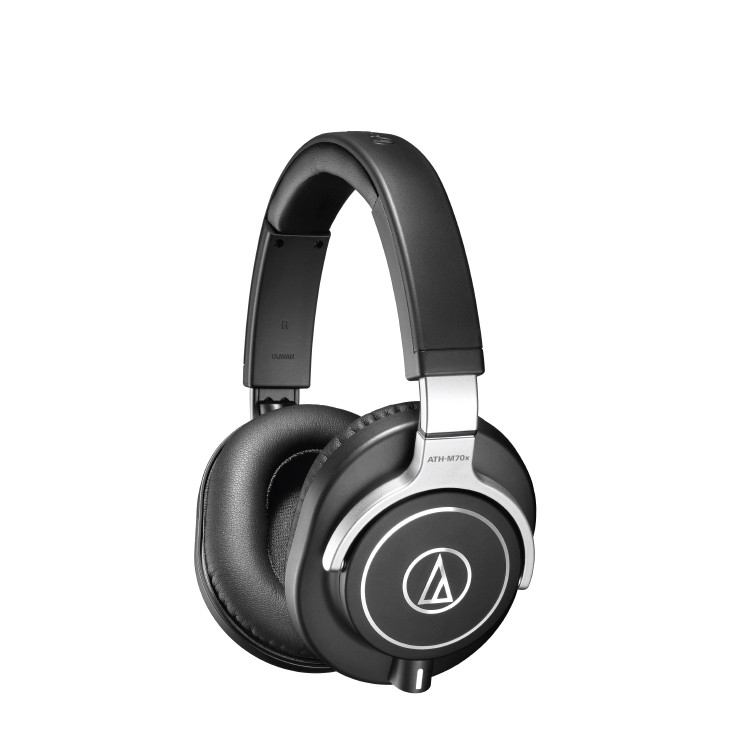
There's a reason professional mastering engineers tend to be picky about their headphones. When your job is to catch the tiniest imperfections in a recording — a barely audible click, a subtle phase issue, a sibilance problem hiding in the upper frequencies — you need monitoring tools that don't sugarcoat anything. The Audio-Technica ATH-M70x was built precisely for that kind of work.
Sitting at the top of Audio-Technica's acclaimed M-Series lineup, the ATH-M70x isn't trying to be the most popular headphone in the range. That title comfortably belongs to the M50x, which has become something of a modern classic. Instead, the M70x targets a narrower audience: engineers, producers, and broadcast professionals who need the most accurate closed-back monitoring Audio-Technica can offer. It's a tool, not a toy — and that distinction matters more than you might think.
In this guide, we'll break down exactly what the ATH-M70x delivers, who it's genuinely suited for, where it outperforms the rest of the M-Series, and where you might be better off looking elsewhere. If you're an Australian audio professional weighing up whether these flagship cans deserve a spot in your studio, you're in the right place.
Want to see the full specs and current pricing? Check out the Audio-Technica ATH-M70x at MusiconStage — authorised Australian dealer with free shipping.
What Makes the ATH-M70x Different from Every Other M-Series Headphone
Audio-Technica's M-Series is one of the most widely used studio headphone lines in the world. The M20x, M30x, M40x, and M50x each serve a specific tier of the professional and prosumer market. But the M70x was designed with a fundamentally different philosophy than the rest of the range.
While the M50x balances accuracy with a slightly engaging low end — making it versatile for everything from tracking to casual listening — the M70x strips away any colouration. Its purpose is pure accuracy. Audio-Technica engineered these headphones to reveal exactly what's in a recording, nothing more, nothing less. For critical mixing and mastering tasks, that uncompromising transparency is precisely the point.
The Frequency Response Story
The headline specification is the ATH-M70x's extraordinary 5 Hz – 40,000 Hz frequency response. Compare that to the M50x at 15 Hz – 28,000 Hz or the M40x at 15 Hz – 24,000 Hz, and you can see the M70x occupies a completely different tier of performance. That sub-bass extension down to 5 Hz means you'll hear — or more accurately, feel — the lowest rumbles in a recording. The 40 kHz ceiling extends well beyond human hearing, which might sound pointless on paper but contributes to more accurate reproduction of transients and harmonic overtones in the audible range.
In practical terms, this means the M70x lets you make mixing decisions with greater confidence across the full frequency spectrum. Low-frequency mud that the M40x might gloss over becomes immediately apparent. High-frequency harshness that even the M50x slightly rounds off is laid bare. For mastering work where you're making subtle, surgical adjustments measured in fractions of a decibel, that transparency is invaluable.
Driver Technology
The ATH-M70x uses proprietary 45mm large-aperture drivers featuring rare-earth magnets and copper-clad aluminium wire voice coils. These aren't just bigger versions of the drivers in the M50x — they're a purpose-built design optimised for resolution and accuracy rather than impact or excitement.
The copper-clad aluminium wire is a deliberate engineering choice. Pure copper would be heavier, adding mass to the voice coil and potentially slowing transient response. Pure aluminium would be lighter but offer slightly higher electrical resistance. The hybrid approach gives Audio-Technica the responsiveness they need while keeping the driver assembly light enough for detailed, fast reproduction. It's a small detail, but these small details stack up when you're designing a reference-grade transducer.
Complete Technical Specifications
| Specification | ATH-M70x |
|---|---|
| Type | Closed-back, circumaural (over-ear) |
| Driver Diameter | 45mm large-aperture |
| Magnet Type | Rare earth (neodymium) |
| Voice Coil | Copper-clad aluminium wire |
| Frequency Response | 5 Hz – 40,000 Hz |
| Impedance | 35 ohms |
| Sensitivity | 98 dB/mW |
| Maximum Input Power | 2,000 mW at 1 kHz |
| Weight (without cable) | Approximately 283g |
| Cable Type | Detachable with locking mechanism |
| Connector | 3.5mm gold-plated (6.3mm adapter included) |
A few things worth noting in these specs. The 35-ohm impedance means you won't necessarily need a dedicated headphone amplifier to drive the M70x — they'll work from most audio interfaces and even portable devices. However, a quality headphone amp will let the drivers breathe and reveal their full dynamic range, particularly at lower volumes where detail retrieval matters most.
The 98 dB/mW sensitivity is slightly lower than some competitors, which means they won't get as loud per milliwatt of power. In practice, this is rarely an issue in a studio environment where you're monitoring at controlled levels. If anything, it's a gentle reminder that these headphones were designed for critical listening, not cranking dance tracks at maximum volume.
Build Quality and Design: Where the Premium Shows
Pick up a pair of M70x headphones and you immediately feel the difference from the M50x. The machined aluminium construction gives the ear cups a solid, professional heft that plastic housings simply can't match. This isn't just aesthetics — metal housings provide better resonance control, reducing unwanted vibrations that could colour the sound.
Comfort and Fit
The ear cups feature memory foam cushions covered in professional-grade leatherette. They're circumaural, meaning they sit around your ears rather than on them, which helps with both comfort and noise isolation. The 90-degree swivel allows for single-ear monitoring — a must-have for engineers who need to compare headphone and speaker monitoring quickly, or for broadcast work where you need one ear on the room.
Now, here's where honesty matters. The ATH-M70x has a notably firm clamping force straight out of the box. During the first few weeks of use, sessions longer than two to three hours can become uncomfortable, particularly if you wear glasses. The headband padding is adequate but not luxurious. This is a genuine consideration — some engineers find them perfectly comfortable after a break-in period, while others invest in aftermarket ear pads for longer sessions.
The 180-degree collapsible design lets you fold the headphones flat for storage and transport, and Audio-Technica includes a soft carrying pouch for this purpose. It's worth noting they don't include a hard case — an odd omission at this price point, though aftermarket cases are readily available.
Cable System
Audio-Technica includes two detachable cables with the M70x:
- 1.2-metre coiled cable — ideal for studio desk work where you want some give without excessive slack
- 3.0-metre straight cable — better suited for tracking rooms or situations where you need to move around
Both cables use a proprietary locking mechanism that clicks into the left ear cup. The locking design prevents accidental disconnections during sessions — a small but thoughtful touch for professional environments. The 3.5mm gold-plated connectors are solid, and the included 6.3mm screw-on adapter means you're ready for both portable and professional connections right out of the box.
One caveat: the proprietary connector means you can't simply use any 3.5mm cable as a replacement. If you need a spare or a different length, you'll need to source Audio-Technica–compatible cables specifically. Third-party options exist, but it's worth being aware of this before purchasing.
Real-World Performance: Where the M70x Earns Its Keep
Mixing and Mastering
This is the ATH-M70x's natural habitat. The flat, neutral frequency response means your mix decisions translate well to other playback systems. If a kick drum sounds balanced on the M70x, it'll likely sound balanced on studio monitors, car speakers, and earbuds alike. That translation confidence is what mixing engineers are ultimately paying for.
The extended sub-bass response is particularly useful for genres where low-frequency content is critical — electronic music, hip-hop, film scoring. You can hear and feel what's happening below 30 Hz, which is territory the M50x simply can't reach with the same clarity. For mastering engineers making final EQ decisions in the low end, this matters enormously.
High-frequency detail retrieval is equally impressive. Sibilance issues in vocal recordings, harsh cymbal overtones, digital clipping artefacts — the M70x reveals these problems unflinchingly. Some engineers find this level of detail fatiguing during long sessions, which is a fair criticism. These headphones don't flatter anything, and that honesty can be uncomfortable when working with less-than-perfect source material.
Broadcast and Voice-Over
The closed-back design provides excellent sound isolation, which makes the M70x well-suited for broadcast environments. Presenters can monitor their own voice with minimal leakage into nearby microphones — a critical requirement for professional broadcast studios. The detailed midrange reproduction means you'll hear every nuance of vocal delivery, from subtle room reflections to mouth noise.
Audio Post-Production
Film and television audio engineers will appreciate the M70x's ability to reveal subtle details in dialogue recordings. Breath noise, clothing rustle, background hum — the kind of problems you need to identify and address during post-production become immediately audible. The extended frequency response also benefits Foley work and sound design, where overtones and textural details are crucial.
Tracking and Recording
While the M70x can certainly be used for tracking sessions, it's arguably overkill for this purpose. Most musicians and vocalists don't need reference-grade accuracy when laying down takes — they need a comfortable headphone with good isolation and enough low-end presence to feel connected to the music. The M50x or even the M40x are better choices for tracking applications, both in terms of comfort and tonal character.
Considering the ATH-M70x for your studio setup? Browse pricing and availability at MusiconStage — your authorised Audio-Technica dealer in Australia.
ATH-M70x vs ATH-M50x vs ATH-M40x: An Honest Comparison
Since these three headphones share the same family name and similar design DNA, the comparison question is inevitable. Here's how they genuinely stack up.
| Feature | ATH-M40x | ATH-M50x | ATH-M70x |
|---|---|---|---|
| Frequency Response | 15 Hz – 24,000 Hz | 15 Hz – 28,000 Hz | 5 Hz – 40,000 Hz |
| Driver Size | 40mm | 45mm | 45mm |
| Impedance | 35 ohms | 38 ohms | 35 ohms |
| Sensitivity | 98 dB/mW | 99 dB/mW | 98 dB/mW |
| Weight | ~240g | ~285g | ~283g |
| Build Material | Primarily plastic | Plastic with metal accents | Machined aluminium |
| Sound Signature | Flat, slightly lean | Slight bass emphasis | Neutral, analytical |
| Best For | Budget studio work | Versatile studio/DJ/casual | Critical mixing & mastering |
| Included Cables | 2 (coiled + straight) | 3 (coiled + 2 straight) | 2 (coiled + straight) |
When the M70x Is Worth the Premium
If your primary work involves mixing, mastering, or quality control — tasks where accuracy directly impacts the final product — the M70x justifies its price. The wider frequency response, superior build quality, and more neutral sound signature give you monitoring confidence that the M50x can't quite match.
The difference isn't night and day. It's more like switching from a good pair of studio monitors to a great pair. You'll notice details you didn't hear before, particularly in the extreme low and high frequencies. Whether those details are worth the price difference depends entirely on your work.
When the M50x Is the Smarter Buy
For most musicians, producers, content creators, and even many professional engineers, the M50x remains the better value proposition. It's more comfortable for long sessions, more versatile across different applications (studio, DJ, casual listening), and costs significantly less. If you're not doing dedicated mastering or broadcast monitoring work, the M50x covers ninety percent of what the M70x offers at a fraction of the price.
This isn't a criticism of the M70x — it's simply an acknowledgement that reference-grade accuracy is a specialised need. You wouldn't buy a surgeon's scalpel to slice bread, and you don't need a mastering headphone for bedroom production.
Who Should Actually Buy the ATH-M70x
Based on genuine use-case analysis, here's who benefits most from the M70x:
- Mastering engineers who need the most accurate closed-back monitoring available
- Mixing engineers who regularly work in untreated rooms and rely heavily on headphone monitoring
- Broadcast professionals who need detailed, isolated monitoring for live or recorded content
- Audio post-production specialists working on dialogue editing, Foley, or sound design
- Quality control engineers at pressing plants, streaming services, or record labels
- Audiophiles who genuinely value accuracy over entertainment (though understand these are tools, not consumer headphones)
Who Should Look Elsewhere
Equally important — here's who the M70x probably isn't suited for:
- Bedroom producers and hobbyists — the M50x or M40x will serve you better at lower cost
- DJs — the analytical sound and clamping force make these impractical for DJ monitoring
- Casual listeners — the neutral, revealing sound can be unflattering for relaxed music enjoyment
- Musicians tracking in the studio — comfort and a slightly warmer tone make the M50x better for long recording sessions
- Anyone wanting a single do-everything headphone — the M70x is a specialist tool, not a Swiss Army knife
What's in the Box
Audio-Technica packages the ATH-M70x with everything you need for professional use:
- ATH-M70x headphones
- 1.2m coiled detachable cable
- 3.0m straight detachable cable
- 6.3mm (1/4") screw-on adapter
- Soft carrying pouch
- User documentation and warranty information
The absence of a hard case is worth mentioning. At this price tier, competitors like the Beyerdynamic DT 1770 Pro include a hard carrying case as standard. If you plan to transport the M70x regularly, budget for a third-party hard case to protect your investment.
Honest Pros and Cons
Strengths
- Exceptional frequency response (5 Hz – 40 kHz) — among the widest in any closed-back monitor headphone
- Truly neutral sound signature — no hype, no colouration, just accuracy
- Premium aluminium build — feels and performs like a professional tool
- Excellent isolation — effective sound rejection for studio and broadcast environments
- Detachable cable system — practical for professional use with locking mechanism
- 35-ohm impedance — easy to drive from most sources without a dedicated amp
- 90-degree swivel — essential for single-ear monitoring in professional settings
Weaknesses
- Firm clamping force — can be uncomfortable for extended sessions, especially for glasses wearers
- Analytical sound isn't for everyone — relentlessly revealing, potentially fatiguing during long work days
- Proprietary cable connector — limits replacement cable options
- No hard case included — surprising omission at this price point
- Diminishing returns vs M50x — the performance gap may not justify the price gap for many users
- Closed-back soundstage limitations — if you want a wide, open sound, no closed-back design competes with open-back alternatives
Comparing with the Competition
The ATH-M70x doesn't exist in a vacuum. Here's how it measures up against the headphones Australian professionals commonly cross-shop.
Beyerdynamic DT 1770 Pro
The DT 1770 Pro is arguably the M70x's closest competitor. It offers Tesla driver technology, a similarly neutral sound signature, and includes both velour and leatherette ear pads plus a hard case. Many engineers find the DT 1770 Pro more comfortable for extended sessions, though Audio-Technica's sub-bass extension is superior. The Beyerdynamic typically sits in a similar price bracket in Australia.
Sennheiser HD 280 Pro
A completely different proposition — the HD 280 Pro costs a fraction of the M70x's price and is widely used in professional studios for tracking. It doesn't compete on resolution or frequency extension, but for engineers building a studio on a budget, it's a reminder that excellent professional headphones exist at every price point.
Open-Back Alternatives
If isolation isn't a requirement, open-back headphones like the Sennheiser HD 600/650 or beyerdynamic DT 900 Pro X offer wider soundstage and often superior comfort. Many mastering engineers actually prefer open-back designs for critical work and use closed-back models only when isolation is necessary. If your studio environment is quiet enough, an open-back design might serve you better than any closed-back, regardless of price.
Buying the ATH-M70x in Australia: What You Need to Know
Australian buyers have several advantages when purchasing through authorised dealers like MusiconStage. Here are the key considerations:
Warranty and Consumer Protection
Purchasing through an authorised Australian dealer ensures you receive full manufacturer warranty coverage. Australia's consumer law also provides additional protections beyond the manufacturer's warranty — products must be of acceptable quality, fit for purpose, and match their description. This protection applies regardless of the manufacturer's stated warranty period, which is a significant advantage over grey imports.
Pricing Considerations
The ATH-M70x typically retails in the range of AUD $499 – $699 depending on the retailer and current promotions. While you might find lower prices from international sellers, keep in mind that grey imports won't carry local warranty and may not be covered by Australian consumer guarantees. The price difference often isn't worth the risk when you're investing in a professional tool.
Availability
As a flagship model, the M70x can occasionally be out of stock with some retailers. If you need them urgently for a project, it's worth checking availability before committing. Authorised dealers like MusiconStage maintain stock of Audio-Technica's professional range and can advise on availability and expected restock dates.
Practical Tips for Getting the Best from Your M70x
If you do decide to invest in the ATH-M70x, here are some practical suggestions to maximise your experience:
- Allow a break-in period — both for the ear pad foam to soften and for the clamping force to ease. Give them a week or two of regular use before making final comfort judgements.
- Consider a headphone amplifier — while the M70x runs fine from an audio interface, a dedicated amp (even a modest one) can improve dynamic range and detail at lower monitoring volumes.
- Learn their sound — spend time listening to well-mastered reference tracks you know intimately. Understanding how your favourite recordings sound on the M70x helps you calibrate your mixing decisions.
- Use them for checking, not just mixing — even if you primarily mix on speakers, the M70x is invaluable as a checking tool to catch problems your monitors might miss.
- Invest in a headphone stand — proper storage extends ear pad life and keeps the headband from warping.
Frequently Asked Questions
Do the ATH-M70x need a headphone amplifier?
Not strictly. At 35 ohms and 98 dB/mW sensitivity, they'll produce adequate volume from most audio interfaces, mixing consoles, and even smartphones. However, a quality headphone amp will unlock their full dynamic potential, particularly for critical listening at moderate volumes. Think of it as optional but beneficial — not a requirement, but a worthwhile addition if your budget allows.
Are the ATH-M70x comfortable for long sessions?
This is subjective, but the consensus is that the M70x requires a break-in period. The clamping force is noticeably firm out of the box. After a few weeks of use, the headband loosens and the memory foam ear pads conform to your head shape. Some engineers work in them all day without issues; others find them taxing after three to four hours. If comfort is your top priority and you can sacrifice some isolation, consider trying them before committing.
Can I use the ATH-M70x for music listening?
You can, but you might not enjoy it as much as you'd expect. The M70x's strictly neutral sound signature means music doesn't have the warmth or bass enhancement that most consumer headphones provide. Poorly mastered recordings will sound noticeably worse. If you're the type of listener who appreciates technical accuracy and wants to hear music exactly as the engineer intended, you might love them. For relaxed, enjoyable listening, the M50x is a better companion.
How do the ATH-M70x compare to open-back headphones for mastering?
Open-back headphones generally offer a wider soundstage and more natural spatial presentation, which many mastering engineers prefer. The M70x's advantage is isolation — if your room isn't acoustically quiet, or if you need to block out external noise, the M70x provides reference-grade monitoring in a closed-back format. Many professionals keep both types in their toolkit and choose based on the session's requirements.
Are replacement ear pads and cables available in Australia?
Yes. Audio-Technica replacement ear pads and cables are available through authorised dealers. Third-party alternatives also exist, though quality varies. For the ear pads, some engineers prefer aftermarket options with different materials (velour, for instance) for improved comfort during long sessions. Just ensure any third-party cable uses the correct proprietary locking connector.
The Verdict: A Specialist's Tool That Delivers What It Promises
The Audio-Technica ATH-M70x doesn't pretend to be something it's not. It's not the most comfortable headphone in the M-Series. It's not the best value. It's not the most versatile. What it is, unequivocally, is the most accurate closed-back monitor headphone Audio-Technica makes — and one of the most revealing closed-back headphones available at any price.
If your work demands that level of accuracy, the M70x is an investment that pays for itself through better mix decisions, fewer revision cycles, and greater confidence in your monitoring chain. The extended frequency response, neutral tuning, and premium build quality make it a serious professional tool worthy of serious studio work.
If that's not what you need, that's perfectly fine. The M50x remains one of the best all-round studio headphones ever made, and there's no shame in choosing it over the M70x for general production work. Buying the right tool for the right job is what professionals do.
For Australian engineers who need flagship closed-back monitoring, though, the ATH-M70x delivers exactly what it promises — unflinching accuracy for the ears that demand it.
Ready to add the ATH-M70x to your studio? Order from MusiconStage — authorised Australian dealer with free shipping and full warranty coverage.