
Allen & Heath Qu-5D: Dante-Ready 32-Channel Mixer for Networked Audio 2025
Allen & Heath Qu-5D: Dante-Ready 32-Channel Mixer for Networked Audio 2025
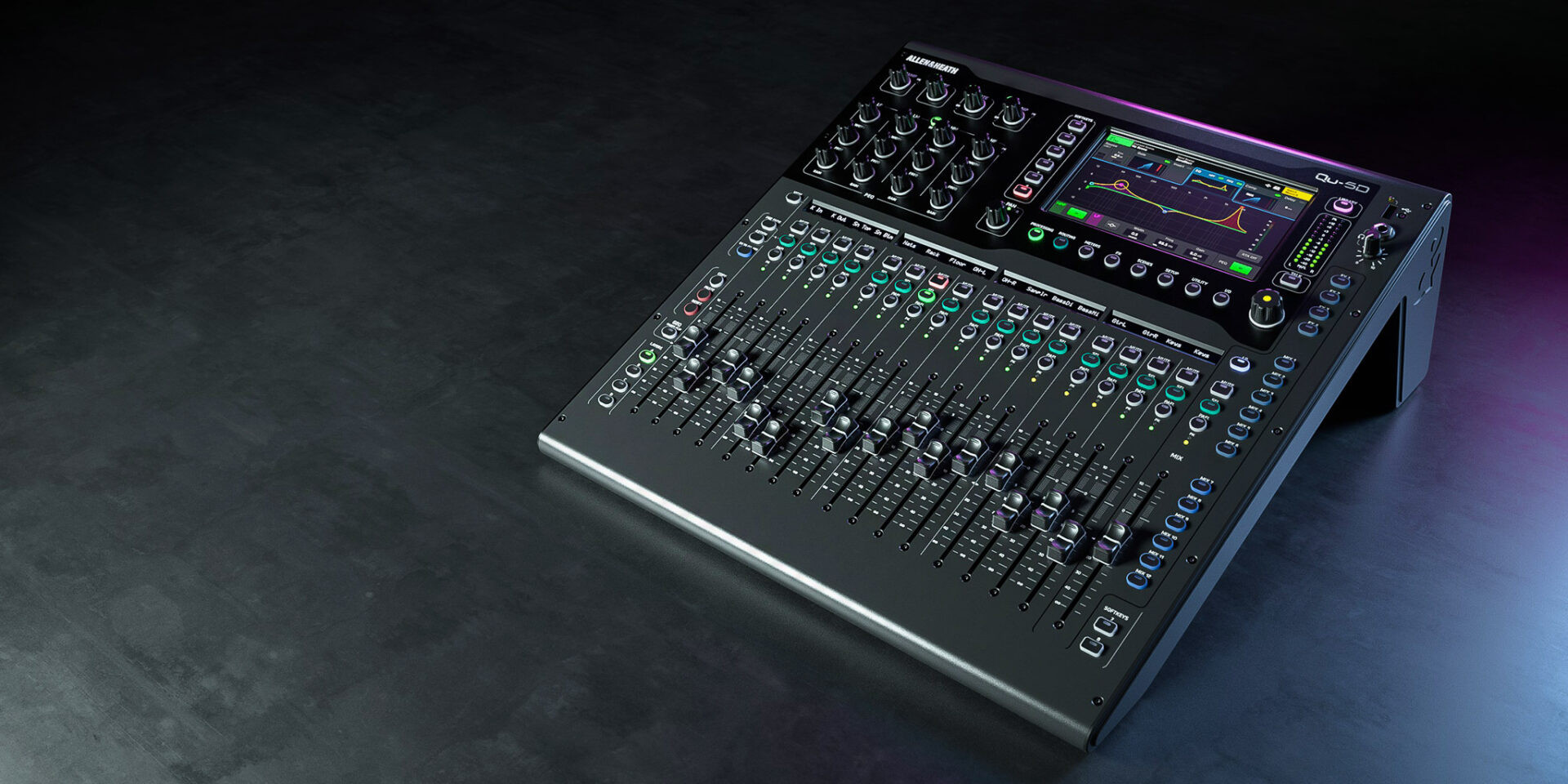
When Allen & Heath released the Qu series, they fundamentally changed what mid-range digital mixers could deliver. The Qu-5D represents the current evolution of that thinking—a compact 32-channel mixer with native Dante integration that slots into networked audio systems without requiring additional interface cards or adapters. For Australian venues, production companies, and broadcast facilities looking to expand their audio-over-IP capabilities, this mixer addresses a genuine gap in the market.
I've spent considerable time examining the Qu-5D's architecture, and what stands out isn't just the feature list—it's how thoughtfully Allen & Heath has integrated Dante at the hardware level rather than treating it as an afterthought. This isn't a standard Qu-5 with a network card bolted on; it's a purpose-built networked audio console.
Core Technical Specifications
Before diving into the deeper technical analysis, let's establish exactly what the Qu-5D delivers from a specification standpoint:
| Specification | Qu-5D Details |
|---|---|
| Total Input Channels | 32 channels (mixing architecture) |
| Sample Rate | 96kHz / 48kHz selectable |
| Bit Depth | 24-bit |
| Physical Faders | 17 (100mm motorised) |
| Local Mic/Line Inputs | 16 (TRS/XLR combo) |
| Local Line Outputs | 12 |
| Dante I/O | 16 x 16 channels |
| Internal Effects | 6 stereo FX engines |
| Mix Buses | 10 mix outputs + LR |
| DCA Groups | 4 |
| Mute Groups | 4 |
| USB Recording | Qu-Drive (18-track to USB) |
| Remote Control | Qu-You, Qu-Pad apps |
Understanding the 96kHz Processing Advantage
The Qu-5D's 96kHz operation isn't marketing fluff—it has measurable implications for audio quality. At 96kHz, you're capturing frequency content up to 48kHz (Nyquist frequency), which extends well beyond human hearing. So why does it matter?
The real benefit lies in the anti-aliasing filter behaviour. At 48kHz, the anti-aliasing filter needs to work harder to prevent frequencies above 24kHz from aliasing back into the audible spectrum. This filter can introduce phase anomalies in the upper frequencies that, while subtle, affect the perceived "air" and transient response of the audio.
At 96kHz, the anti-aliasing filter operates an octave higher, well outside the audible range. The result is cleaner phase response throughout the audible spectrum, particularly noticeable on transient-rich material like drums and percussion. For live sound applications where monitoring is critical, this translates to slightly improved clarity in the upper midrange and high frequencies.
There's a trade-off, naturally. Running at 96kHz halves the available Dante channel count compared to 48kHz operation. The Qu-5D's 16x16 Dante specification assumes 96kHz operation—at 48kHz, you'd theoretically have bandwidth for more channels, but the mixer's architecture is optimised for the higher sample rate.
Dante Integration: What It Actually Means for Your Setup
Dante (Digital Audio Network Through Ethernet) has become the de facto standard for professional audio networking, and the Qu-5D's native implementation deserves detailed examination.
Network Architecture
The Qu-5D features dual Gigabit Ethernet ports for Dante, supporting redundant network configurations. This isn't just about backup—redundant Dante networks allow you to run primary and secondary paths, with automatic failover if one network path fails. For installed systems in venues or broadcast facilities, this redundancy is often a requirement rather than a luxury.
The mixer uses Audinate's Brooklyn II module, the current-generation Dante chipset that supports sample-accurate synchronisation across the network. Clock management is handled automatically through Dante Controller software, with the Qu-5D capable of acting as clock leader or follower depending on your system configuration.
Practical Dante Applications
The 16x16 Dante I/O opens up several workflow possibilities that aren't available on non-networked mixers:
- Distributed stage boxes: Rather than running a single large stagebox, you can position multiple smaller Dante-enabled input devices across a stage or venue, all feeding the Qu-5D over standard Cat6 cabling.
- Recording integration: Send 16 channels directly to a DAW via Dante Virtual Soundcard, bypassing additional interfaces. This is particularly valuable for broadcast applications where you need clean splits to multiple destinations.
- Distributed monitoring: Feed Dante-enabled personal monitor mixers or amplifiers directly from the console without dedicated analogue splits.
- Multi-console systems: Share channels between multiple Dante-enabled consoles, allowing FOH and monitor engineers to access the same sources independently.
For Australian production companies handling corporate events, the Dante capability means faster setup times. Running a single Cat6 cable between stage and FOH position, rather than a multicore snake, reduces pack-down time and eliminates a common failure point.
Local I/O Configuration: 16 In, 12 Out
The "16/12" local I/O specification tells you what you can connect directly to the mixer without network infrastructure:
Input Section
All 16 local inputs use combo XLR/TRS connectors, accepting both microphone and line-level sources. The preamps are the same design found throughout the Qu range—remote-controllable with a gain range of +6dB to +60dB for microphones, switchable to line level (+/- 10dB trim range) for line sources.
Phantom power (+48V) is available on all inputs, switchable in groups of four channels rather than individually. This is a minor limitation if you're mixing dynamic and condenser microphones on adjacent channels, but rarely causes practical issues.
The preamps measure a quoted EIN (Equivalent Input Noise) of -128dBu (150Ω, unweighted), which places them in professional territory. This specification matters for capturing quiet sources—classical recordings, acoustic ensembles, or distant ambient microphones—where preamp noise becomes audible.
Output Section
Twelve local outputs provide sufficient physical connections for most applications: main left/right, several monitor mixes, and auxiliary feeds. All outputs use balanced TRS connectors with a maximum output level of +22dBu, ensuring adequate headroom for driving power amplifiers or broadcast distribution systems.
The 17-Fader Layout Explained
The Qu-5D's 17 motorised faders require some explanation for those unfamiliar with digital console architecture. You're not limited to 17 inputs—the faders are assignable across the 32-channel architecture via layer switching.
The standard configuration gives you:
- 16 channel faders across two layers (Inputs 1-16 and 17-32)
- 1 master fader for main LR output
- Custom fader layers for grouping frequently-used channels
The motorised faders (100mm throw) physically recall positions when switching layers, providing immediate visual feedback of your mix state. This is essential for live work where you need to see levels at a glance.
Allen & Heath's "Custom Layer" feature allows you to cherry-pick channels from anywhere in the architecture—say, lead vocal, kick, snare, bass, and main effects returns—onto a single layer for performance mixing. It's a workflow feature that becomes indispensable once you've configured it for your typical show.
Six Stereo FX Engines: What's Actually Inside
The Qu-5D includes six independent stereo effects processors, which is generous for a console at this price point. These aren't simple delay and reverb units—they're full-featured processors drawing from Allen & Heath's iLive FX library.
Available Effect Types
| Category | Available Effects |
|---|---|
| Reverbs | EMT250, Plate, Hall, Room, Ambience, Gated |
| Delays | Stereo Delay, Ping Pong, Tape Delay, Multi-tap |
| Modulation | Chorus, Flanger, Phaser, ADT, Rotary |
| Special | Ring Modulator, Transient Shaper, Symphonic |
The EMT250 emulation deserves special mention. It's a faithful recreation of the original digital reverb that defined the sound of countless recordings from the late 1970s onward. Having this available as a live effect—rather than requiring an outboard unit—is genuinely useful for vocal treatment.
Each FX engine has dedicated send and return routing, tap tempo synchronisation, and full parametric control. The implementation is sophisticated enough for studio-quality effects work, which isn't always the case with console-based processing.
Channel Processing Deep Dive
Every input channel on the Qu-5D receives identical processing capabilities:
Per-Channel Processing Chain
- High-pass filter: 12dB/octave, sweepable 20Hz-400Hz
- Gate/Expander: Full gate or expander mode with depth, attack, hold, release
- Parametric EQ: 4-band fully parametric with shelving options on bands 1 and 4
- Compressor: Full dynamics control with soft/hard knee, sidechain filter
- Delay: Per-channel delay up to 170ms for time alignment
The channel EQ uses algorithms derived from Allen & Heath's higher-end console lines. The parametric bands offer Q values from 0.3 to 8.6, providing everything from broad tonal shaping to surgical notch filtering.
For Australian hire companies dealing with challenging venue acoustics—and there are plenty of those—the combination of per-channel delay and comprehensive EQ means you can handle time alignment and room correction at the channel level rather than requiring outboard processing.
If you're ready to upgrade your live sound or installed audio system with proper Dante networking, check the current Qu-5D pricing at Music on Stage—they ship Australia-wide and can advise on system configuration.
Technical Comparison: Qu-5D vs Competing Networked Mixers
Understanding where the Qu-5D sits in the market requires comparison with direct competitors. Here's how it stacks up technically:
Qu-5D vs Yamaha TF1 + Dante Card
| Specification | Allen & Heath Qu-5D | Yamaha TF1 + NY64-D |
|---|---|---|
| Dante Integration | Native (included) | Optional card (additional cost) |
| Sample Rate | 96kHz native | 48kHz only |
| Total Channels | 32 | 40 |
| Physical Faders | 17 | 17 |
| FX Engines | 6 stereo | 8 (SPX-based) |
| Dante Channels | 16x16 @ 96kHz | 64x64 @ 48kHz |
The Yamaha offers more Dante channels at lower sample rate—relevant if you're building larger networked systems. However, adding Dante to a TF1 requires the NY64-D card, pushing the total investment higher. The Qu-5D's native Dante is a cleaner implementation for straightforward networked applications.
Qu-5D vs Soundcraft Si Expression 1 + MADI-Dante Bridge
The Soundcraft route to Dante requires a MADI stagebox with Dante conversion—a more complex and expensive signal path. For pure Dante integration, the Qu-5D is considerably more elegant and cost-effective.
Qu-5D vs Midas M32R + DN32-DANTE Card
Similar story to the Yamaha—native Dante on the Qu-5D versus add-in card on the Midas. The M32R offers deeper channel count and more buses, but the processing architecture and feature set are in different leagues. For smaller-scale applications where Dante is essential, the Qu-5D makes more sense. For larger productions where Dante is a bonus, the M32R might be more appropriate.
Qu-Drive: Multitrack Recording Without a Computer
The Qu-5D includes Allen & Heath's Qu-Drive system for direct USB recording. A USB drive connected to the rear panel can capture 18 tracks simultaneously—16 individual channels plus a stereo main mix—at the console's operating sample rate.
For virtual soundchecks, this is invaluable. Record the full show, then replay those tracks through the console the next day for tweaking EQ and effects without the band present. Australian tribute acts touring the pub circuit find this particularly useful—dial in a mix at one venue, then recall it at the next.
Recording format is standard WAV, so files transfer directly to any DAW for post-production or archiving. The system also handles playback, useful for walk-in music or backing tracks during live performances.
Remote Control: iOS and Android Apps
Allen & Heath provides two iPad/Android apps for remote control:
Qu-Pad (Engineer)
Full mixing control from a tablet, including all channel parameters, effects, routing, and scene recall. Connect via the console's built-in network port (or an external router for multiple devices) and mix from anywhere in the venue. For engineers who need to walk the room during soundcheck, this is essential.
Qu-You (Personal Monitoring)
A simpler app designed for musicians to control their own monitor mixes. Each musician gets a restricted view showing only their assigned aux mix, preventing accidental changes to other channels. Up to seven Qu-You users can connect simultaneously.
The personal monitoring aspect solves a common problem in Australian venue installations—the sound operator can't always be at the desk during rehearsals, but musicians need monitor adjustments. Qu-You lets them sort themselves out.
Who Should Buy the Qu-5D?
The Qu-5D fills a specific niche in the market. It's not the right choice for everyone, so let's be direct about where it fits:
Ideal Applications
- Small venues upgrading to networked audio: The native Dante makes expanding later straightforward—add networked stageboxes, monitor systems, or recording infrastructure without replacing the console.
- Corporate AV companies: Quick setup via Dante, reliable operation, remote control for client adjustments.
- Broadcast facilities: Clean Dante splits to recording systems, 96kHz operation for broadcast-quality audio.
- Churches with distributed systems: Dante allows feeding lobby areas, cry rooms, and recording systems over IT infrastructure.
- Production companies needing compact networked consoles: Fly-pack friendly with professional connectivity.
Less Suitable For
- Large-scale touring: 32 channels and 10 mix buses may feel limiting for major productions. Consider the Qu-7D or SQ series instead.
- Budget-constrained buyers who don't need Dante: The standard Qu-5 costs less if networking isn't required.
- Users needing maximum Dante channel count: 16x16 is adequate for many applications but limiting for large networked systems.
Australian Purchasing Considerations
Several practical factors affect Australian buyers specifically:
Network Infrastructure Requirements
Dante runs on standard Gigabit Ethernet, but you'll need managed switches for larger systems. Unmanaged switches work for simple point-to-point connections, but once you're running multiple Dante devices, proper QoS (Quality of Service) configuration becomes important. Budget for network infrastructure if you're building a permanent installation.
Australian Support and Service
Allen & Heath products are distributed in Australia through Jands, who maintain local service capabilities and spare parts. This matters for professional applications where downtime is costly. Music on Stage can advise on warranty and support options when you purchase.
Power Considerations
The Qu-5D uses an internal universal power supply (100-240V, 50/60Hz), so Australian 240V mains are fully compatible without adaptors. Power consumption is approximately 65W—modest enough that standard venue circuits handle it comfortably.
For Australian venues, production companies, or broadcast facilities looking to step into Dante-networked audio without massive infrastructure investment, the Qu-5D is available from Music on Stage with Australia-wide shipping.
Technical Specifications Summary
| Category | Specification |
|---|---|
| Mixing Channels | 32 mono + 3 stereo |
| Mix Buses | 10 mono + LR + 4 FX send + 2 stereo matrix |
| Sample Rate | 96kHz / 48kHz |
| Latency (analogue in to out) | 0.7ms @ 96kHz |
| Frequency Response | 20Hz - 40kHz ±0.5dB |
| Dynamic Range | >110dB |
| THD+N | <0.005% @ 1kHz |
| Dante Network Ports | 2x Gigabit (redundant) |
| Dimensions (W x D x H) | 480mm x 513mm x 192mm |
| Weight | 11kg |
Frequently Asked Technical Questions
Can I use the Qu-5D without Dante equipment?
Absolutely. The 16 local inputs and 12 local outputs operate independently of Dante. You can run the console purely on analogue I/O and add Dante devices later as needed.
What Dante devices are compatible?
Any Audinate-certified Dante device. This includes stageboxes from Allen & Heath (AR series), Focusrite RedNet products, Shure wireless receivers, and hundreds of others. Check Audinate's compatibility database for specific devices.
Can I cascade multiple Qu-5D consoles via Dante?
Yes, but with limitations. You can share audio channels between consoles over Dante, but scene and control data don't sync. Each console operates independently for mixing functions.
What's the maximum cable run for Dante?
Standard Ethernet limits apply—100 metres per segment using Cat5e or Cat6 cable. For longer runs, fibre conversion is required.
Does the Qu-5D support AES67?
Not natively. The Brooklyn II module supports Dante only. For AES67 interoperability, you'd need a Dante-AES67 bridge device.
Final Technical Assessment
The Allen & Heath Qu-5D occupies a sensible position in the market—it's a professional-grade digital mixer with native Dante integration at a price point that doesn't require corporate-level budgets. The 96kHz operation, comprehensive effects processing, and mature remote-control ecosystem make it genuinely useful rather than gimmicky.
What impressed me most during examination is the thoughtfulness of the Dante implementation. This isn't a console with networking bolted on as an afterthought—it's designed from the ground up to participate in modern networked audio systems. For Australian users building out Dante infrastructure incrementally, the Qu-5D provides an accessible entry point that doesn't compromise on audio quality or professional features.
The 32-channel architecture with 10 mix buses covers small-to-medium applications comfortably. Larger productions will outgrow it, but that's where the Qu-7D or SQ series step in. For venues, corporate AV, broadcast, and houses of worship, the Qu-5D hits a practical sweet spot.
If native Dante integration, 96kHz operation, and professional Allen & Heath processing align with your requirements, view the full Qu-5D specifications and current pricing at Music on Stage. They're equipped to discuss system design and integration for Australian installations.