
Allen & Heath ZED-12FX Technical Breakdown: Specs That Matter in 2026
Allen & Heath ZED-12FX Technical Breakdown: Specs That Matter in 2026
In a market increasingly dominated by digital consoles, the Allen & Heath ZED-12FX stands as a compelling argument for analogue signal paths done right. But beyond the marketing language, what do the specifications actually tell us? This technical breakdown cuts through the noise and examines every meaningful spec on the ZED-12FX — giving you the engineering context you need to decide whether this mixer belongs in your rig.
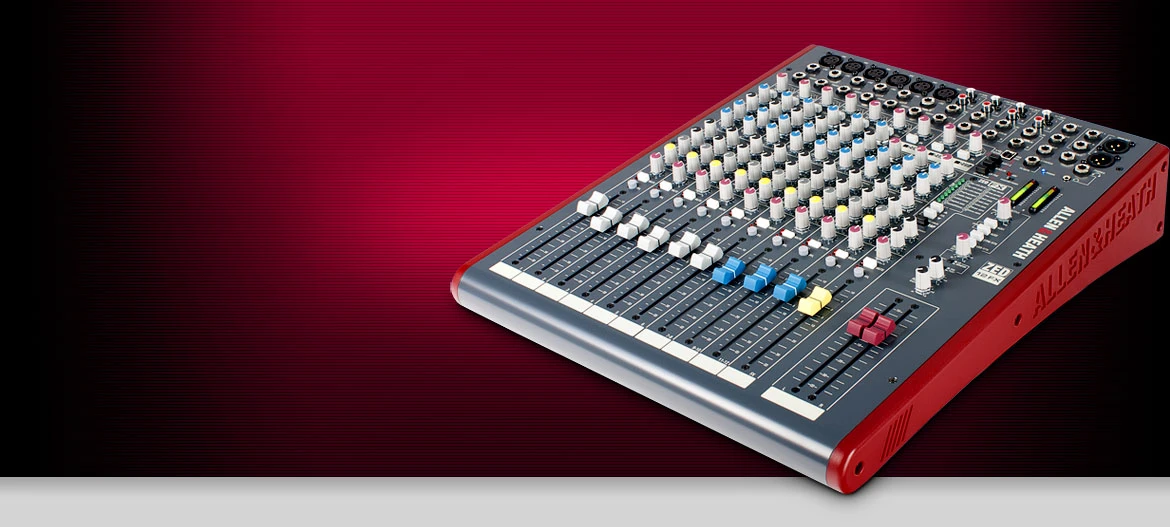
Whether you're running a small venue, rigging up a rehearsal space, podcasting, or tracking in a home studio, understanding what's under the hood matters more than feature lists. Let's get into it.
Channel Architecture: What You're Actually Working With
The ZED-12FX features a channel configuration that's slightly more nuanced than the name suggests. You get six mono mic/line channels, each fitted with Allen & Heath's proprietary DuoPre preamps, plus three stereo input channels. That gives you a total of twelve input sources to the mix bus — hence the name — but the way those channels are structured matters for routing flexibility.
Each mono channel provides an XLR mic input alongside a 1/4-inch TRS line input, with channels 1 and 2 additionally offering high-impedance (Hi-Z) inputs on the front panel. This is a genuinely useful inclusion. Running a guitar or bass directly into a mixer without a DI box and maintaining proper impedance matching is something cheaper boards simply can't do properly. The Hi-Z inputs on the ZED-12FX present an input impedance high enough to avoid loading down passive pickups, which preserves the tonal character of the instrument.
The three stereo channels accept 1/4-inch TRS inputs, and each also has an RCA pair for consumer-level gear — handy for connecting laptops, phones, or media players without adapters.
The DuoPre Preamp: Engineering That Actually Matters
Allen & Heath's DuoPre preamp design is arguably the centrepiece of the ZED series, and for good reason. These aren't the same circuits you find in budget mixers from other manufacturers. The DuoPre topology uses a two-stage design: the first stage handles the low-noise amplification, while the second provides the gain range — keeping the noise floor low across the full gain sweep.
Key Preamp Specifications
| Parameter | Specification | What It Means |
|---|---|---|
| Equivalent Input Noise (EIN) | -127 dBu (150Ω, 20Hz-20kHz) | Exceptionally quiet for this price class |
| Gain Range | +10 dB to +69 dB | Handles everything from hot line signals to quiet ribbon mics |
| Frequency Response | 20Hz – 20kHz ±0.5 dB | Flat, transparent response across audible range |
| THD+N | <0.009% (1kHz, 0dBu) | Distortion well below audible threshold |
| Phantom Power | +48V switchable | Global phantom — not per-channel |
That EIN figure of -127 dBu deserves context. In practical terms, this means the preamps add virtually no audible noise even when you're running dynamic microphones at high gain settings. Compare this to many competing compact mixers in the same price bracket where EIN figures sit around -120 to -122 dBu, and you're looking at a meaningful 5-7 dB advantage. That translates directly to cleaner recordings and less hiss in live reinforcement scenarios.
One technical consideration worth noting: the phantom power on the ZED-12FX is globally switched, not per-channel. If you're running ribbon microphones alongside condensers, you'll need to be mindful of this. Most modern ribbon mics handle phantom power without damage, but vintage or budget ribbons may not — check your mic's specifications before engaging phantom.
EQ Section: The MusiQ Approach
Allen & Heath calls their EQ topology "MusiQ," and while the name sounds like marketing, the engineering behind it is genuinely considered. Each mono channel features a three-band EQ: a fixed high shelf at 12kHz, a swept mid (120Hz–4kHz), and a fixed low shelf at 80Hz.
The swept mid is where this mixer distinguishes itself from competitors. Many compact mixers in this class offer only fixed-frequency EQ across all three bands, which severely limits your corrective ability. Having a sweepable mid means you can hunt for problematic frequencies — a boxy vocal resonance around 300Hz, a nasal guitar cab peak at 800Hz, or a harsh cymbal overtone at 3.5kHz — and cut them precisely. In a live setting, this capability can be the difference between a muddy mix and a clear one.
The EQ boost/cut range is ±15 dB across all bands. That's generous — perhaps more than you'd typically need. In practice, if you're pushing past ±6 dB on any band, you're likely dealing with a source problem that EQ alone won't solve. But having that headroom means you're never fighting the desk for range.
The stereo channels feature a simpler two-band EQ (high and low shelving filters), which is appropriate for stereo sources like playback devices or keyboard outputs that typically need less corrective processing.
Built-In FX Engine: What's Actually Inside
The "FX" in ZED-12FX refers to the onboard effects processor, which provides 16 effect presets. This is powered by a dedicated DSP chip and fed via a single auxiliary send (FX send), with the return routed back into the mix bus.
Effects Breakdown
- Reverbs (multiple variants): Hall, plate, room, and spring emulations — these are the workhorses for live vocal applications
- Delays: Various delay types including tap-tempo capable patterns
- Modulation: Chorus and flange effects for instrument processing
- Combination effects: Reverb + delay combos for one-knob convenience
Let's be candid about the FX quality. These onboard effects are perfectly serviceable for live applications — a touch of hall reverb on vocals, a slap delay on a guitar — but they won't replace dedicated outboard processors or plugin chains for critical recording work. The reverb tails lack the complexity and decay character you'd get from a quality dedicated unit or software reverb. For live sound in small venues, pubs, and function spaces, they're absolutely fine and save you the cost and hassle of external processing. For studio tracking, you're better off recording dry and adding effects in your DAW.
Each channel has an independent FX send level control, giving you per-channel control over how much signal hits the processor. The overall FX return level is adjusted at the master section. It's a simple but effective implementation.
Auxiliary Sends and Routing
The ZED-12FX provides two auxiliary sends on the mono channels: one pre-fade (AUX 1) and one post-fade (AUX 2/FX). The pre-fade aux is essential for monitor mixes in live applications — it lets you build a monitor send that's independent of your front-of-house mix adjustments. The post-fade send doubles as the FX send, so your effects level tracks with your fader moves.
For many users, a single monitor send will be adequate for small gigs where the whole band shares one monitor mix. If you need multiple independent monitor mixes, you'll need to step up to a larger console like the ZED-16FX or ZED-22FX.
Bus Architecture
| Bus | Type | Application |
|---|---|---|
| Main LR | Stereo mix bus | Front of house / main output |
| AUX 1 | Pre-fade mono send | Monitor mix |
| AUX 2 / FX | Post-fade mono send | Effects send or second aux |
| USB | Stereo record bus | Stereo recording to computer |
USB Audio Interface: Recording Capabilities
The ZED-12FX includes a built-in USB audio interface operating at 16-bit/48kHz. This provides a stereo send and return between the mixer and your computer, turning the ZED-12FX into a recording interface.
Here's where you need to manage expectations. The USB implementation captures the main stereo mix — not individual channels. You get a stereo mixdown recorded directly into your DAW, which is perfectly adequate for recording rehearsals, capturing live performances, podcasting, or streaming. But if you need multitrack recording with individual channel isolation for post-production mixing, you'll need a dedicated audio interface or a mixer with multitrack USB capability (like the Allen & Heath Qu series or the ZEDi range).
The 16-bit resolution is worth noting. While 24-bit has become the standard for professional recording, 16-bit at 48kHz is CD-quality audio and provides a theoretical dynamic range of 96 dB. For live capture and content creation, this is more than adequate. You'd only notice the difference in very dynamic material where the extra headroom of 24-bit recording would give you more margin for error in gain staging.
The USB return path allows you to route computer audio back through the mixer, which is useful for backing tracks, click tracks, or incorporating DAW playback into a live mix.
Build Quality and Physical Design
Allen & Heath has a well-earned reputation for robust build quality, and the ZED-12FX continues this tradition. The chassis uses a steel construction — not the plastic housings found on some competing mixers — which provides genuine touring durability and effective electromagnetic shielding.
The 60mm faders feel smooth with appropriate resistance. They're not the 100mm faders you'd find on larger format consoles, but they provide sufficient travel for accurate level setting. The knobs are firm with minimal play, and the rotary pots have a reassuring, consistent feel throughout their travel — a sign of quality potentiometer selection.
The overall footprint is compact enough for tight spaces but not cramped. Channel spacing provides enough room for adult fingers to make adjustments without accidentally nudging adjacent controls — something that can't be said for every compact mixer.
Physical Specifications
| Parameter | Detail |
|---|---|
| Dimensions (W x D x H) | Approximately 318 x 338 x 72 mm |
| Weight | Approximately 4.5 kg |
| Power Supply | External AC adapter |
| Fader Type | 60mm linear |
| Metering | LED bar graph (main output) |
The external power supply is a minor inconvenience for some — it's one more thing to pack and potentially lose — but it keeps the internal circuitry isolated from power supply noise, which contributes to that clean signal path.
How the ZED-12FX Compares: Technical Perspective
Positioning the ZED-12FX against its direct competitors reveals where it genuinely excels and where compromises exist.
vs. Yamaha MG12XU
The Yamaha offers similar channel count with SPX effects and 24-bit USB audio — a clear advantage in recording resolution. However, the Yamaha's D-PRE preamps, while clean, don't match the DuoPre's noise floor performance. The ZED-12FX also offers the sweepable mid EQ, which the Yamaha lacks in this class. If recording quality is your primary concern, the Yamaha edges ahead on USB specs. If analogue signal quality and EQ flexibility matter more, the Allen & Heath wins.
vs. Soundcraft Signature 12
The Soundcraft brings Lexicon effects and dbx limiters on the input channels — both genuinely useful additions. Its preamp performance is comparable, and the Lexicon effects are arguably superior to the ZED-12FX's onboard processing. The Allen & Heath counters with build quality that's a step above and the sweepable mid EQ. This is a genuinely close contest, and your choice might come down to whether you value the input limiters (Soundcraft) or the EQ flexibility (Allen & Heath).
vs. Mackie ProFX12v3
The Mackie offers 24-bit USB recording and Mackie's GigFX effects suite. Build quality is solid but uses more plastic in the construction. The Onyx preamps are good but the ZED-12FX's DuoPre circuit measures better on noise floor. The Mackie is typically priced lower, making it a strong value proposition if outright preamp quality isn't your top priority.
Real-World Application Scenarios
Small Venue Live Sound
This is arguably the ZED-12FX's sweet spot. Six mic channels cover a typical small band configuration (vocals, snare, kick, plus a couple of instrument mics), while the stereo channels handle keyboards and backing tracks. The pre-fade aux provides a workable monitor send, and the onboard effects add polish to vocals without external gear. The DuoPre preamps ensure your signal chain starts clean, which is critical when you're working without the luxury of outboard processing.
Podcast and Content Production
For a multi-host podcast, the ZED-12FX works well. You can run up to six microphones with individual level control, use the USB output to capture directly into your recording software, and monitor through headphones via the dedicated headphone output. The lack of individual channel USB outputs means you're committed to getting your mix right at the board, but for many podcasters, a well-balanced stereo mix is all they need.
Home Studio Tracking
Here the ZED-12FX serves best as a monitoring mixer and preamp front-end. The DuoPre preamps are genuinely good enough for serious recording — route individual channel direct outputs (via the insert points using a Y-cable technique) into a dedicated multitrack interface for per-channel recording. The mixer then handles your monitoring, talkback, and headphone mixes. It's not a purpose-built recording console, but it integrates well into a hybrid setup.
Rehearsal Space Mixer
Durability and straightforward operation make the ZED-12FX ideal for a permanent rehearsal room installation. The steel chassis withstands the inevitable bumps and spills, the controls are intuitive enough that any band member can adjust their levels, and the built-in effects mean you don't need additional rack gear for basic vocal processing.
Technical Considerations Before You Buy
What the Specs Don't Tell You
The ZED-12FX's specifications are impressive on paper, but there are practical considerations that don't appear in spec sheets:
- Headroom: The internal mix bus operates with generous headroom, meaning you can push the mixer hard before clipping — but this also means proper gain staging is essential to take full advantage of the signal-to-noise ratio
- Global phantom power: As mentioned, this is a single switch for all channels. Plan your mic selection accordingly
- No channel muting: Unlike digital consoles, there are no mute buttons on individual channels. You'll manage this with faders, which is standard for analogue mixers in this class but worth noting if you're used to digital workflows
- Single monitor send: If your gigs require multiple independent monitor mixes, you'll outgrow this mixer quickly
Future-Proofing Assessment
Analogue mixers don't become obsolete the way digital gear can. There's no firmware to become unsupported, no software compatibility concerns, and no risk of a manufacturer discontinuing essential app support. The ZED-12FX will perform identically in ten years as it does today — which is both its limitation and its strength. You won't get new features via updates, but you also won't lose functionality.
The 16-bit USB implementation is the one area where age shows. As 24-bit and 32-bit float recording become standard, the USB recording capability may feel increasingly dated. However, since most users employing a mixer like this will eventually pair it with a dedicated interface for serious recording work, this is less of a practical concern than it might seem.
Specification Summary
| Category | Specification |
|---|---|
| Mono Mic/Line Channels | 6 (with DuoPre preamps) |
| Stereo Input Channels | 3 |
| Hi-Z Inputs | 2 (Channels 1 & 2) |
| EQ (Mono) | 3-band with sweepable mid (120Hz–4kHz) |
| EQ (Stereo) | 2-band shelving |
| Aux Sends | 2 (1 pre-fade, 1 post-fade/FX) |
| Effects | 16 presets (reverb, delay, modulation) |
| USB Audio | Stereo, 16-bit / 48kHz |
| EIN | -127 dBu |
| THD+N | <0.009% |
| Frequency Response | 20Hz–20kHz ±0.5dB |
| Main Outputs | XLR balanced stereo |
| Phantom Power | +48V global |
The Verdict: Who Should Buy the ZED-12FX?
The Allen & Heath ZED-12FX is a technically accomplished compact analogue mixer that punches above its weight class on preamp quality and EQ flexibility. It's not trying to be everything — it doesn't offer multitrack recording, motorised faders, or wireless control — but what it does, it does with genuine engineering integrity.
Buy it if: You prioritise analogue signal quality, need a reliable workhorse for small live gigs or rehearsal spaces, want Allen & Heath build quality without stepping up to their digital range, or need a clean preamp front-end for a hybrid studio setup.
Look elsewhere if: You need multitrack USB recording, require multiple independent monitor sends, want digital recall and scene storage, or need more than six mic inputs.
For Australian musicians, venue operators, and content creators who value signal quality and durability over digital feature sets, the ZED-12FX remains one of the smartest compact mixer investments you can make. The DuoPre preamps alone justify the price premium over budget alternatives — everything else is a bonus.
Check the current price and availability of the Allen & Heath ZED-12FX at MusiconStage — Australia's trusted source for pro audio gear.
Frequently Asked Technical Questions
Can I use the ZED-12FX as a standalone USB audio interface?
Yes, but with limitations. It provides a stereo USB output of the main mix at 16-bit/48kHz. It functions as a class-compliant USB device on most operating systems without additional drivers. However, you only get the stereo mix — not individual channels — so it's suitable for podcast capture, live recording, or streaming, but not multitrack production.
Is the ZED-12FX suitable for recording drums?
With six mic channels, you can run a basic drum mic setup (kick, snare, overhead pair, plus one or two toms or room mics). The DuoPre preamps handle the transient-heavy nature of drum signals well. The limitation is the stereo-only USB output — you'd want to route through a multitrack interface for proper drum production work.
How does the ZED-12FX handle in hot Australian conditions?
The steel chassis dissipates heat effectively, and the external power supply keeps the main unit cooler than designs with internal power supplies. For outdoor gigs in Australian heat, the ZED-12FX is more thermally resilient than plastic-bodied alternatives. Standard precautions apply: keep it shaded and allow airflow around the unit.
Can I rack-mount the ZED-12FX?
Allen & Heath does not offer a rack-mount kit for the ZED-12FX. Its form factor is designed for desktop or surface mounting. If rack-mounting is essential, consider the ZEDi range or the Qu-SB for a rackmountable Allen & Heath option.
Ready to upgrade your audio setup? Grab the Allen & Heath ZED-12FX from MusiconStage today.