
Allen & Heath Qu-7d Performance Analysis: 33-Fader Dante Mixer 2026
Allen & Heath Qu-7d Performance Analysis: 33-Fader Dante Mixer 2026
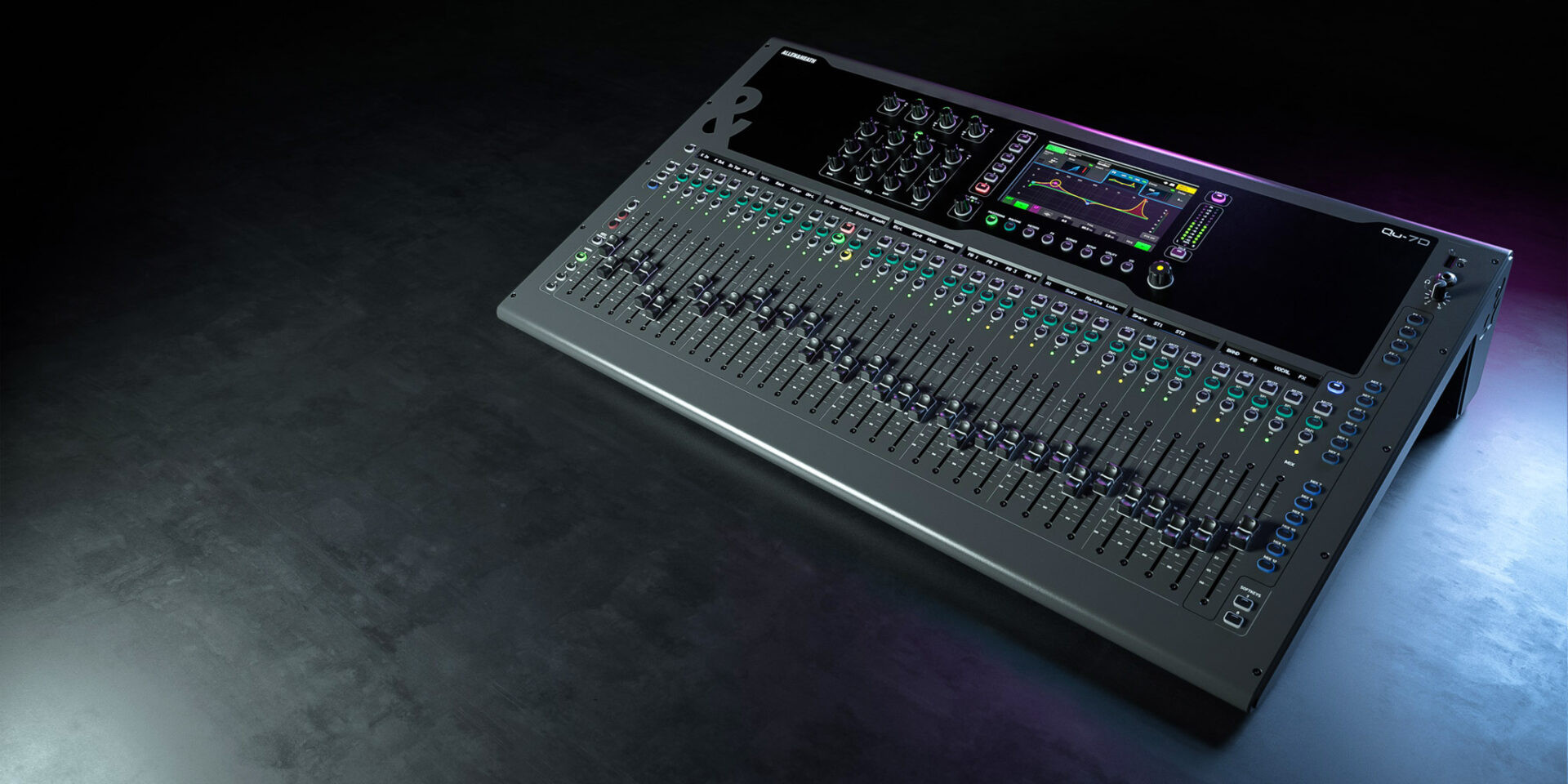
The Allen & Heath Qu-7d is the flagship of the reimagined Qu-d range, and on paper it reads like a console built to retire the original Qu-32 rather than simply succeed it. A 96kHz signal path, native Dante, 38 input processing channels, 24 mix outputs and 33 motorised faders place it in an unusual position: a compact, single-operator desk with the I/O count and networking flexibility you'd normally associate with much larger systems. This analysis breaks down what those numbers actually mean in practice, where the engineering matters, and which specifications deserve your attention before you commit.
Technical Overview: Reading the Spec Sheet Correctly
The model name encodes most of what you need to know. "38 In" refers to processing channels available at the mixing surface, not just physical sockets — this includes local mic/line inputs, stereo channels, the USB return and networked sources collapsed into the channel architecture. "24 Out" describes the available mix buses and physical outputs across the local connectors and the Dante/dSNAKE network. "96k" is the headline change: the entire Qu-d platform runs its FPGA-based audio engine at 96kHz, double the 48kHz of the original Qu series.
The practical consequence of 96kHz operation is not simply "more samples." It widens the usable analogue-to-digital bandwidth, pushes anti-aliasing filter artefacts further out of the audible range, and — combined with the redesigned converters — measurably lowers noise and improves transient handling on percussive and high-frequency sources. For most live applications the audible benefit is subtle, but the lower latency that high sample rates enable is genuinely useful for in-ear monitoring and any workflow routing audio through the USB interface.
Core Architecture at a Glance
| Specification | Qu-7d | Why It Matters |
|---|---|---|
| Audio engine | FPGA, fixed-architecture, 96kHz | Predictable, low latency; no plugin crashes or CPU spikes |
| Input processing | 38 channels | Comfortable headroom for mid-to-large band, theatre or worship inputs |
| Mix outputs | 24 (mono/stereo aux, groups, matrix, mains) | Multiple monitor mixes plus zone/matrix feeds simultaneously |
| Faders | 33 motorised, 100mm | Near one-fader-per-channel access; recall and layer changes are physical |
| Preamps | AnalogiQ recallable mic preamps | High headroom, transparent gain; padless design avoids switching artefacts |
| Networking | Native Dante (64x64 class) + dSNAKE | Standards-based audio over IP plus legacy AudioRack support |
| Onboard recording | Qu-Drive multitrack to USB | Virtual soundcheck and live capture with no external rig |
| USB audio interface | Multichannel I/O to DAW | Studio tracking and post-production from the same surface |
The AnalogiQ Preamp Stage: Where the Real Upgrade Lives
Specification tables tend to fixate on channel counts, but the most consequential engineering change in the Qu-d platform is the preamp. The AnalogiQ stage uses a padless gain architecture, meaning gain is applied as one continuous range rather than switching a fixed attenuation pad in and out of circuit. Pad-switched designs introduce a small but real discontinuity in tone and noise behaviour at the switching point — eliminating it produces smoother gain staging and a cleaner noise floor across the entire range.
Combined with the wider dynamic range of the 96kHz converters, the result is a front end that tolerates hot sources — close-miked snares, brass, aggressive vocalists — with more headroom before clipping. For engineers who have wrestled with the original Qu's behaviour on high-SPL inputs, this is the single most noticeable real-world improvement, more so than the sample-rate bump itself.
I/O and Routing: Understanding 38-In / 24-Out in Context
A 38-input, 24-output topology is deceptively flexible. In a typical Australian gigging scenario — a function band with backline, horns and tracks — you might use 24 to 28 inputs, leaving genuine spare capacity rather than running at the ragged edge of the desk. The 24 outputs are where the Qu-7d earns its keep: you can dedicate a generous number of buses to monitor sends (wedges and IEMs), reserve groups for stems, and still have matrix outputs free for delay zones, broadcast feeds or a separate foyer/overflow speaker.
Routing is handled in the fixed FPGA architecture, which is an important reliability point. Because the signal path is not running as software on a general-purpose CPU, there is no scenario where adding processing causes audio dropouts, buffer underruns or a crash mid-show. Every channel has its full processing chain available all the time. This determinism is a core reason touring and install engineers continue to specify Allen & Heath FPGA desks over plugin-host competitors.
Per-Channel Processing Chain
- High-pass filter: variable, for removing stage rumble and proximity buildup
- Gate: per-channel, essential for drum kits and busy multi-mic stages
- Parametric EQ: four-band fully parametric with shelving options
- Compressor: per-channel with multiple response characteristics
- DEEP processing: embedded preamp emulations and dynamics models derived from Allen & Heath's larger consoles, running natively with no DSP penalty
- Delay: per-channel alignment for distance and phase correction
The DEEP processing point deserves emphasis. Unlike plugin ecosystems where authentic-sounding emulations consume processing budget and can force trade-offs, DEEP models are integrated into the fixed architecture. You can instantiate them across many channels without watching a CPU meter — a meaningful workflow advantage when you are mixing alone under time pressure.
Dante Networking: The Specification That Future-Proofs the Desk
Native Dante is arguably the headline reason to choose a Qu-d over a used original Qu. Dante is the de facto standard for professional audio-over-IP in Australia, used across broadcast, install, touring and education. Native integration means the Qu-7d appears directly on a Dante network without an add-on card occupying a slot — useful for:
- Digital stageboxes: a single Cat-style cable run instead of a heavy analogue multicore
- Recording rigs: patching the full multitrack stream to a Dante-equipped interface or laptop for capture and virtual soundcheck
- System integration: sharing audio with DSP processors, broadcast playout or distributed-zone systems in fixed installs
- Redundancy: Dante's primary/secondary scheme supports resilient network topologies for critical events
Crucially, the Qu-d range retains the dSNAKE port alongside Dante. This protects existing investments in Allen & Heath AudioRacks (AR2412, AR84, AB168). If you already run a Qu-based system with dSNAKE expanders, the Qu-7d slots in without forcing a wholesale stagebox replacement — you can adopt Dante incrementally. That hybrid stance is a pragmatic engineering decision and a genuine cost consideration for upgrading venues.
If you're weighing a networked upgrade path for your room or rig, the full Qu-7d specifications and current Australian pricing are listed here for a closer look at the connector layout.
Surface and Workflow: Why 33 Faders Changes the Mix
Fader count is not vanity. With 33 motorised 100mm faders, the Qu-7d gets close to a one-knob-per-function feel for the majority of inputs without constant layer paging. For a solo operator running front-of-house and monitors from one position — the reality at most Australian functions, club gigs and houses of worship — physical access to faders is the difference between a controlled show and a frantic one.
The motorised faders recall positions instantly on scene change, so a multi-act night or a service with distinct segments becomes a series of reliable recalls rather than manual re-balancing. The touchscreen handles deeper editing — routing, processing detail, library management — while the faders and dedicated controls keep time-critical adjustments tactile. This division of labour (physical for fast moves, screen for setup) is the workflow philosophy that has made the Qu line a default recommendation for single-operator environments.
Onboard Recording and the USB Interface
The Qu-Drive multitrack recorder writes directly to a USB drive, enabling two high-value workflows: capturing a live multitrack for later mixing, and virtual soundcheck — playing the recorded multitrack back through the desk to set levels and tune the system before the band arrives. For touring and corporate work this can reclaim significant setup time and de-risk technically demanding events.
Separately, the multichannel USB audio interface turns the Qu-7d into a tracking front end for a DAW, with the AnalogiQ preamps feeding your recording software directly. For studios, schools and content creators, that dual role — live console and studio interface in one box — materially improves the value equation versus buying separate gear.
How the Qu-7d Compares Technically
| Consideration | Qu-7d (Qu-d range) | Original Qu-32 | SQ-series (e.g. SQ-7) |
|---|---|---|---|
| Sample rate | 96kHz | 48kHz | 96kHz (XCVI core) |
| Dante | Native, built-in | Optional module | Optional module |
| Preamps | AnalogiQ, padless | Earlier-generation | Higher-end, deeper processing |
| Processing depth | DEEP models, full per-channel chain | Standard Qu chain | More extensive, larger FX/processing budget |
| Operator focus | Single-operator, fast access | Single-operator | Power users, larger productions |
| Typical value position | Best balance of I/O, networking and price | Budget/used pathway | Premium capability, higher cost |
The honest technical read: against the original Qu-32, the Qu-7d is a clear generational step — 96kHz, native Dante and AnalogiQ preamps are not marketing gloss but measurable, workflow-relevant upgrades. Against the SQ series, the decision is about ceiling versus value. SQ desks offer a deeper processing budget and more elaborate signal handling for complex productions; the Qu-7d delivers the I/O count and networking most working venues actually need at a more accessible price, with a faster learning curve. If your shows are not pushing the limits of channel-level processing complexity, the Qu-7d's value proposition is strong.
Which Specifications Actually Matter When You Buy
- Real input requirement, not theoretical maximum: count your worst-case stage plot, add roughly 20% headroom, and confirm the 38-channel architecture clears it comfortably. It almost certainly will for typical Australian gigs.
- Output bus allocation: map your monitor mixes, group stems and matrix/zone feeds before purchase. The 24-output structure is the spec to scrutinise if you run many IEM mixes.
- Networking path: decide now whether you're going Dante, staying dSNAKE, or running both. The hybrid capability is a genuine cost lever for staged upgrades.
- Architecture type: the FPGA, fixed-processing design is a reliability feature, not a limitation. For live work, deterministic behaviour beats open-ended plugin counts that can destabilise mid-show.
- Future-proofing: 96kHz and native Dante meaningfully extend the desk's useful service life against where the industry is heading.
A common technical red flag to avoid: buying purely on headline channel count while ignoring output bus structure and networking. The number of inputs rarely limits a working engineer; the flexibility of outputs and the audio transport almost always does.
Real-World Performance Scenarios
Function and corporate band (single operator): 24–30 inputs, four to six monitor mixes, matrix feed to a recording or broadcast device. The Qu-7d sits well within capacity with motorised recall handling set changes — a strong fit.
House of worship: mixed musicians, multiple speech mics, livestream feed and overflow zones. Automatic mic mixing handles speech intelligibility, DEEP processing tightens dynamics, and Dante simplifies the stream/zone integration. Another strong fit.
Small-to-mid touring: a Dante stagebox replaces the multicore, Qu-Drive provides virtual soundcheck, and the fixed architecture removes the show-stopping-crash risk. Excellent fit, with the caveat that very processing-heavy productions may eventually want an SQ-class ceiling.
Studio plus live hybrid: the USB interface and AnalogiQ preamps make it credible as a tracking front end between gigs, consolidating two purchases into one. Strong value fit for schools and project studios.
Technical FAQ
Does 96kHz actually sound better than 48kHz here?
The audible difference in a live room is subtle and easily overstated. The genuine benefits are improved transient handling on high-frequency sources, cleaner filter behaviour and lower latency through the system — the latter being the most practically relevant for IEM monitoring and USB workflows.
Can I use my existing Allen & Heath AudioRacks?
Yes. The Qu-d range retains the dSNAKE port alongside native Dante, so AR2412, AR84 and AB168 racks continue to work. This allows a phased migration to Dante rather than a forced, expensive replacement.
Is the fixed FPGA architecture a limitation compared with plugin-based mixers?
For live sound it is generally an advantage. Every channel always has its full processing chain with no CPU budget to manage and no risk of a processing-induced crash during a show. Plugin-host flexibility matters more in studio contexts than in live single-operator environments.
Is the Qu-7d overkill for a small venue?
Only if you will never grow into the I/O. The spare input capacity, output flexibility and Dante path are exactly what extends a desk's useful life as a venue's needs expand — buying with headroom is usually the more economical long-term decision.
Expert Verdict
The Allen & Heath Qu-7d is a technically coherent flagship: it pairs a deterministic 96kHz FPGA engine with the AnalogiQ preamp upgrade, native Dante, a generous 38-in/24-out topology and a 33-fader surface engineered for the single operator. The standout engineering decisions — padless preamps, DEEP processing without a DSP penalty, and the dSNAKE/Dante hybrid — are the kind that show up in day-to-day workflow rather than just on a spec sheet.
For Australian function bands, houses of worship, education facilities and small-to-mid touring rigs, it represents the sweet spot of the digital mixing market in 2026: more capability and networking than the original Qu, at a far more accessible price and learning curve than premium SQ-class consoles. If your shows demand reliability, fast tactile access and a future-proof audio transport, it earns a confident recommendation.
Compare the detailed connector layout, processing specification and current Australian pricing on the Allen & Heath Qu-7d product page at MusiconStage, or reach out for tailored advice on integrating it into your existing Dante or dSNAKE system.