
Allen & Heath Qu-6d Specs & Performance: 96kHz Dante Mixing Analysed 2026
Allen & Heath Qu-6d Specs & Performance: 96kHz Dante Mixing Analysed for 2026
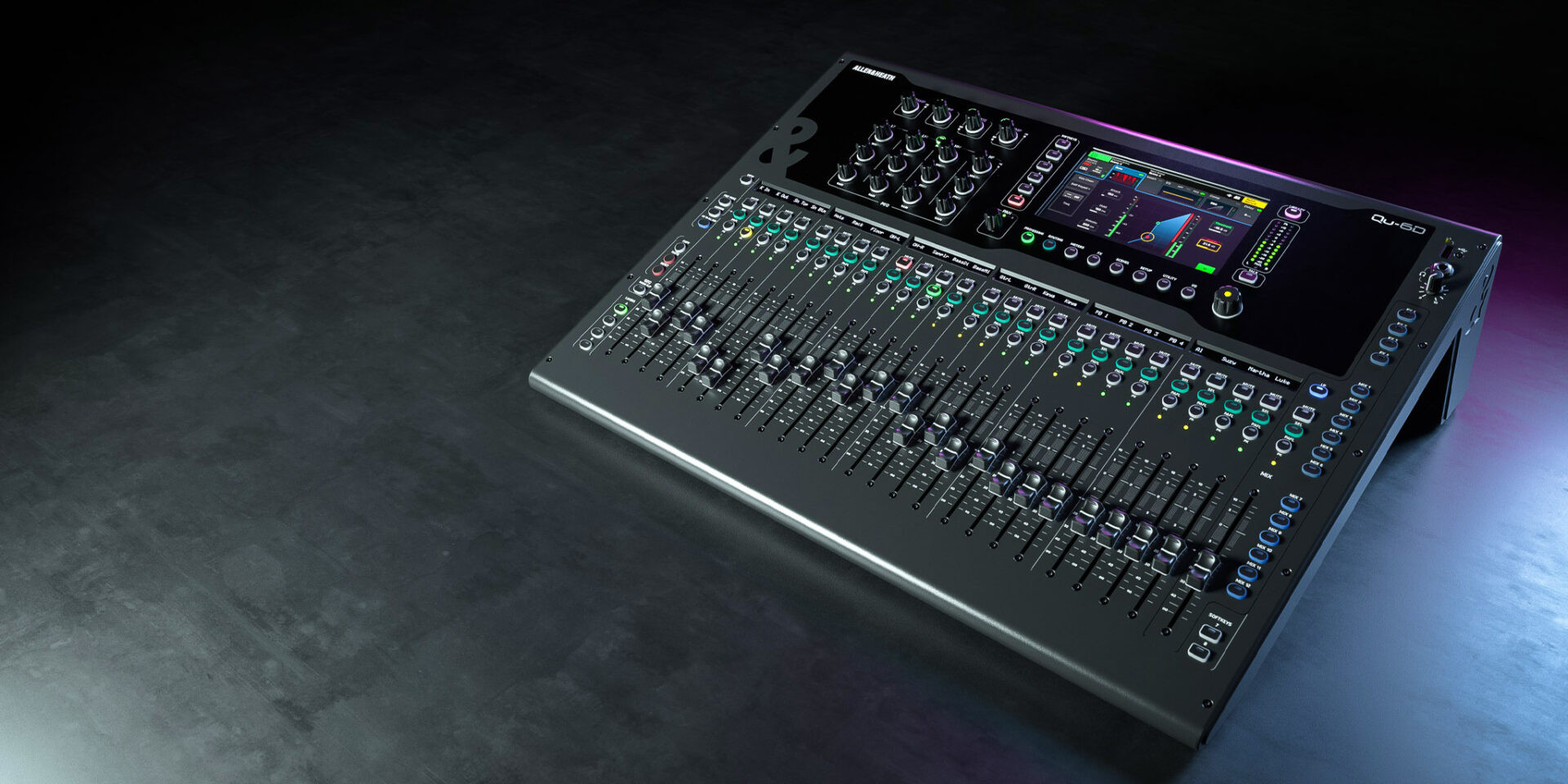
The Allen & Heath Qu-6d occupies a very specific and increasingly important niche in the digital mixing landscape: it's a compact-form-factor console that pairs the proven Qu-series mixing architecture with integrated Dante networking, all running at a native 96kHz sample rate. For Australian venues, hire companies, and installed sound operations looking to step into networked audio without abandoning a familiar workflow, the Qu-6d represents a genuinely compelling proposition.
Having spent considerable time with the Qu platform across various configurations, what stands out about the 6d variant isn't any single headline feature — it's how the combination of 25 motorised faders, 32 mix channels, 16x16 Dante I/O, and 24/16 local analogue I/O comes together in a surface that doesn't demand a dedicated truck to transport. Let's pull apart the specifications and work out what they actually mean for your workflow.
Core Architecture: What 96kHz Actually Delivers
First, let's address the sample rate, because it's one of the Qu-6d's most technically significant differentiators within its price bracket. Running natively at 96kHz isn't just a number on a spec sheet — it has tangible implications for audio quality, latency, and processing headroom.
At 96kHz, the Nyquist frequency sits at 48kHz, which means the anti-aliasing filters in the analogue-to-digital converters can operate with a much gentler slope. The practical result? Less phase distortion in the audible high-frequency range (above roughly 15kHz), and a more transparent, open sound on sources like cymbals, acoustic instruments, and vocal sibilance. You won't necessarily hear a dramatic difference on a kick drum, but on a full band mix with detailed high-frequency content, the difference between 48kHz and 96kHz processing is audible on decent monitoring.
The trade-off, historically, has been that 96kHz operation halves your available channel count or processing power. Allen & Heath have engineered around this limitation with the Qu-6d — you still get the full 32 input processing channels, all effects engines, and the complete mix bus structure at the higher sample rate. That's a significant engineering achievement at this price point.
Channel Architecture and Signal Flow
Understanding the Qu-6d's channel structure requires looking beyond the simple "32-channel" headline. Here's how it actually breaks down:
| Parameter | Specification | Real-World Implication |
|---|---|---|
| Input Processing Channels | 32 total | Full mix capability for medium-large events |
| Local Mic/Line Inputs | 24 (XLR/TRS combo) | Handles most live gigs without external stagebox |
| Local Outputs | 16 (XLR) | Enough for complex monitor mixes plus FOH |
| Dante Network I/O | 16 × 16 | Full bidirectional audio networking |
| Motorised Faders | 25 (100mm) | Physical control over all critical channels/buses |
| Mix Buses | 12 (configurable) | Mono/stereo aux, group, and matrix routing |
| Stereo Groups | 4 | Subgrouping for drums, vocals, etc. |
| FX Engines | 6 (iLive-ported) | Studio-quality effects without external racks |
| Sample Rate | 96kHz native | Superior converter performance and headroom |
| Bit Depth | 24-bit | 144dB theoretical dynamic range |
The 24 local inputs with 16 local outputs mean that for the vast majority of Australian pub gigs, corporate events, and worship installations, you won't need any additional hardware to get signals in and out of the console. The local I/O is comprehensive enough to handle a full band plus several DI sources, with outputs covering monitors, fills, and recording feeds.
The Dante Integration: Why 16×16 Matters
This is where the Qu-6d starts to separate itself from the standard Qu-6. The integrated 16×16 Dante interface isn't an afterthought or a bolt-on card — it's built into the console's core architecture.
What Dante Actually Does in Practice
For those less familiar with Dante (Digital Audio Network Through Ethernet), it's an audio-over-IP protocol developed by Audinate that allows uncompressed, multi-channel digital audio to travel over standard Gigabit Ethernet infrastructure. In the context of the Qu-6d, the 16×16 Dante capability means:
- 16 channels of audio can be sent from the Qu-6d onto the Dante network — these could be direct outputs, mix buses, or any other patchable source within the console's architecture
- 16 channels of audio can be received from the Dante network into the Qu-6d — from stageboxes, other consoles, playback systems, or any Dante-enabled device
- Standard Cat5e/Cat6 cabling replaces expensive multicore copper runs — a single Ethernet cable can carry all 16 channels in each direction
- Network redundancy is available through Dante's primary/secondary network architecture
In a practical Australian venue context, this opens up workflows that were previously only available on significantly more expensive platforms. You could run a Dante-enabled stagebox (like the Allen & Heath AR2412 or AB168) over a single Cat6 cable to the stage, while simultaneously feeding audio to a recording system, a broadcast split, or a second console — all over the same network infrastructure.
Dante at 96kHz: The Bandwidth Consideration
Here's a technical detail worth understanding: Dante at 96kHz uses twice the bandwidth per channel compared to 48kHz operation. On a Gigabit Ethernet network, this isn't a practical limitation for the Qu-6d's 16×16 channel count — you're well within the protocol's capacity. However, if you're building a larger Dante network with multiple devices, factor in the higher per-channel bandwidth when planning your network topology and switch capacity.
Latency on the Dante side is impressively low. At 96kHz with the default Dante latency setting of 1ms, the contribution to overall system latency is negligible. Combined with the Qu-6d's internal processing latency (approximately 0.7ms input to output at 96kHz), your total console latency sits comfortably below 2ms — well under the threshold where performers would notice any delay in their monitor feeds.
Preamp and Converter Quality
The Qu-6d uses Allen & Heath's proprietary recallable preamp design, which deserves a closer technical examination. Each of the mic inputs features:
- Gain range: Adjustable across a wide range with fine resolution, fully recallable via scenes
- Pad: Switchable 20dB pad for handling hot signals from instrument amplifiers or close-miked drums
- Phantom power: Individually switchable 48V phantom on every mic input — this is worth highlighting, as some competing consoles only offer phantom power in groups
- EIN (Equivalent Input Noise): The Qu platform's preamps measure well here, sitting in the low -120dBu range, which is excellent for the price class and comparable to standalone preamps costing significantly more
The converter architecture running at 24-bit/96kHz provides a theoretical dynamic range that exceeds what any live sound environment could practically utilise. More importantly, the converter quality means you can push the system hard on dynamics-heavy material — think uncompressed live drums or orchestral dynamics — without the harsh digital clipping artifacts that characterise lesser converters.
The 25-Fader Control Surface
Twenty-five motorised faders across a console of this size is a strong specification. The fader layout on the Qu-6d follows Allen & Heath's layered approach, where the 25 physical faders can be assigned across multiple layers to access all 32 input channels plus the mix outputs.
The motorised recall is essential for scene-based work. In a multi-act festival scenario (which is bread and butter for Aussie hire companies), you can store complete console states per act and recall them in seconds. The faders physically move to their stored positions, giving you immediate visual and tactile confirmation that the recall has happened correctly. This is a feature that analogue-to-digital converts consistently cite as a game-changer: no more writing fader positions on gaffer tape.
The fader resolution and feel on the Qu series has always been solid. They're smooth, responsive, and have enough physical resistance to prevent accidental nudges during transport or in environments where the console might be bumped. Allen & Heath uses Alps faders across the Qu range — a proven, reliable component choice.
Effects Processing: Six Engines of iLive Heritage
The six internal FX engines in the Qu-6d are ported from Allen & Heath's iLive platform, which was their flagship touring console. This is a significant detail — the effects quality genuinely sits above what you'd typically find in a console at this price point.
The effects library includes:
- Reverbs: Multiple algorithms including hall, plate, room, and chamber — the plate reverb in particular is smooth and musical, holding up well against dedicated outboard units
- Delays: Tap tempo delays with filtering, stereo delays, and multi-tap options
- Modulation: Chorus, flanger, phaser — useful for vocal thickening and instrument effects
- Dynamics: Additional dynamics processing beyond the channel strip, useful for bus compression
Having six simultaneous FX engines means you can comfortably run separate reverbs for vocals and instruments, a delay or two, and still have engines spare for special effects or bus processing. In a live context, this eliminates the need to carry outboard effects racks — one less point of failure and a faster setup.
Channel Processing: The Complete Strip
Every input channel on the Qu-6d features a comprehensive processing strip that includes:
- High-pass filter: Variable frequency, essential for cleaning up low-end rumble on vocal and instrument channels
- 4-band parametric EQ: Fully parametric with adjustable frequency, gain, and bandwidth on each band — this is proper parametric EQ, not the semi-parametric compromises found on some competing desks
- Compressor: Full-featured dynamics processing with threshold, ratio, attack, release, and knee controls
- Gate: Noise gate with threshold, depth, attack, hold, and release parameters
- Insert point: For integrating external processing or the internal FX engines
- Delay: Per-channel delay for time alignment — critical for multi-source setups
This processing chain is available on every single channel simultaneously, at 96kHz. There's no "you can only use the gate on 16 channels" limitation that some budget digital desks impose. The EQ, in particular, is musical and well-implemented — the curves feel natural and behave predictably, which is exactly what you want when you're EQing under pressure during a live show.
Technical Comparison: How the Qu-6d Stacks Up
To properly evaluate the Qu-6d, it's worth comparing it against the alternatives that Australian buyers are most likely considering:
| Feature | Allen & Heath Qu-6d | Yamaha TF1 | Behringer WING |
|---|---|---|---|
| Channels | 32 | 40 | 48 |
| Sample Rate | 96kHz native | 48kHz | 48kHz |
| Dante | 16×16 integrated | Optional card | Via card slot |
| Motorised Faders | 25 | 17 | 24 |
| FX Engines | 6 | 8 | 16 |
| Local Mic Inputs | 24 | 16 | 8 (rear) |
| Touchscreen | 800×480 resistive | 9" capacitive | 10.1" capacitive |
| Preamp Quality | Excellent (A&H design) | Very good (D-PRE) | Good (Midas) |
| Price Class (AUD) | Mid-premium | Premium | Mid |
Several things jump out from this comparison. The Qu-6d's 96kHz operation is unique at this price point — neither the TF1 nor the WING run above 48kHz. The integrated Dante is another advantage; competitors typically require expensive option cards. And 24 local mic inputs is generous — the TF1 only offers 16, and the WING has just 8 on the rear panel (though both support expansion via stageboxes).
Where the Qu-6d gives ground is the touchscreen. Its 800×480 resistive display is functional but not as responsive or visually refined as the capacitive screens on newer competitors. In practice, this matters less than you might think — the Qu-6d's physical controls are well-laid-out enough that you're rarely poking at the screen during a show. But for engineers who've grown accustomed to tablet-style interaction, it's worth noting.
Qu-6d vs Standard Qu-6: Is Dante Worth the Premium?
This is the question many Australian buyers will face. The standard Qu-6 shares the same mixing architecture, channel count, and processing — the 'd' variant adds the 16×16 Dante interface. Is it worth the price difference?
If your answer to any of these questions is "yes," the Dante version justifies its premium:
- Do you need to send audio to a recording system? Dante makes multitrack recording trivially easy — just connect to a computer running Dante Virtual Soundcard
- Are you planning to use networked stageboxes? Dante eliminates heavy analogue multcores and opens up flexible signal routing
- Do you need to split audio to multiple destinations? Broadcast feeds, hearing loop systems, and distributed audio all become straightforward on a Dante network
- Are you installing in a venue that may expand its audio network? Dante future-proofs the installation against evolving requirements
- Do you work in multi-console environments? Sharing channels between FOH and monitor desks is native to Dante's architecture
For a hire company running weekend pub gigs, the standard Qu-6 might suffice. But for installed sound in churches, theatres, and corporate AV, Dante connectivity is increasingly becoming a baseline expectation rather than a luxury. At the current price differential, the Qu-6d is the more future-proof investment.
Practical Considerations for Australian Buyers
Power and Environmental
The Qu-6d runs on an internal universal power supply (100-240V AC), so there are no concerns with Australian mains voltage. It's worth noting that the console draws relatively modest power — important for festival environments where generator capacity is shared across multiple systems. The operating temperature range is suitable for Australian conditions, though as with any digital electronics, keeping the console out of direct sun and ensuring adequate ventilation around the rear panel is sensible practice.
Weight and Transport
At approximately 22kg, the Qu-6d is transportable by one person, though you'll want a proper flight case for regular hire use. The console's footprint is compact enough to fit on standard mixing platforms and FOH risers without issue. For installed applications, it's light enough that standard furniture-style cabinetry can support it without reinforcement.
Software Ecosystem
The Qu-6d is supported by Allen & Heath's Qu-You personal monitoring app (iOS/Android) and the Qu-Pad remote mixing application. The Qu-You app is particularly useful in Australian worship and corporate settings — it allows individual performers to adjust their own monitor mixes from their phones, reducing the number of "more me" requests that arrive at the mix position. Qu-Pad provides full mixing control from a tablet, which is invaluable for system tuning and walking the room during soundcheck.
USB Recording
Beyond Dante, the Qu-6d includes USB streaming for multitrack recording directly to a DAW. At 96kHz, this provides studio-grade capture of live performances — a genuine value-add for bands wanting to record shows or for houses of worship archiving services. The USB implementation supports up to 32 channels of recording and 32 channels of playback simultaneously, making virtual soundcheck a practical reality.
Check the current Australian pricing for the Allen & Heath Qu-6d at MusiconStage
Who Should Buy the Qu-6d — And Who Shouldn't
Ideal For:
- Mid-size venue installations where Dante networking is part of the audio infrastructure plan
- Hire companies wanting a versatile console that can handle corporate AV and live music with equal competence
- Churches and worship venues that need reliable, high-quality mixing with volunteer-friendly operation and recording capability
- Theatre and performing arts where scene recall and deterministic, low-latency performance are essential
- Engineers transitioning from analogue who want a digital console that doesn't require a computer science degree to operate
Consider Alternatives If:
- You need more than 32 channels regularly — look at the Qu-7d (38 channels) or step up to the SQ series
- You require WAVES or third-party plugin integration — the SQ series or competing platforms offer this
- You demand a large touchscreen interface — the Qu-6d's screen is functional but compact; the CQ series or competitors offer larger displays
- You don't need Dante and want to save money — the standard Qu-6 offers identical mixing performance without the network audio capability
Technical FAQs
Can the Qu-6d operate at 48kHz instead of 96kHz?
The Qu-6d is designed to operate at 96kHz natively. This is its fixed operating sample rate, which ensures consistent performance and simplified setup — you don't need to worry about sample rate mismatches between different parts of your signal chain.
Is the Dante implementation AES67-compatible?
The Qu-6d uses Audinate's Dante protocol. While Dante and AES67 can interoperate under certain configurations, native AES67 support depends on the specific Dante firmware version. For pure Dante networks (which covers the vast majority of Australian pro audio installations), compatibility is seamless.
Can I expand beyond 16×16 Dante channels?
The 16×16 Dante I/O is fixed on the Qu-6d. If you need more network channels, you'd be looking at the SQ series, which offers higher Dante channel counts. However, 16×16 is sufficient for most practical applications — it covers a full complement of stage inputs or a complete multitrack recording feed.
What network switches work with the Qu-6d's Dante?
Any managed Gigabit Ethernet switch that supports QoS (Quality of Service) with DSCP will work. Cisco, Netgear Pro, and Luminex are popular choices in Australian pro audio installations. Avoid consumer-grade unmanaged switches for anything beyond simple point-to-point connections.
The Bottom Line: Technical Verdict
The Allen & Heath Qu-6d is a technically mature product that delivers on its specifications without compromise. The 96kHz operation is genuine and audible, the Dante integration is well-implemented, and the mixing architecture provides professional-grade processing on every channel. At its price point in the Australian market, nothing else combines native 96kHz operation with integrated Dante and this level of local I/O.
It's not the newest console on the market, and the touchscreen won't win any design awards. But the Qu-6d is a proven, reliable workhorse that sounds excellent and offers genuine future-proofing through its Dante connectivity. For Australian sound professionals and venues investing in networked audio infrastructure, it represents outstanding value and a technically sound choice.