
Allen & Heath Qu-6d for Newcomers: Digital Mixing Made Simple 2026
Allen & Heath Qu-6d for Newcomers: Digital Mixing Made Simple
If you've just started looking into digital mixing consoles, the specs on a mixer like the Allen & Heath Qu-6d can feel like alphabet soup. Twenty-four faders, 32 channels, 96kHz, 16x16 Dante, six effects engines... what does any of it actually mean for you? Take a breath — you're in the right place. This guide is written for people who are brand new to this world, and by the end you'll understand not just what the Qu-6d does, but whether it's the right tool for where you're heading.
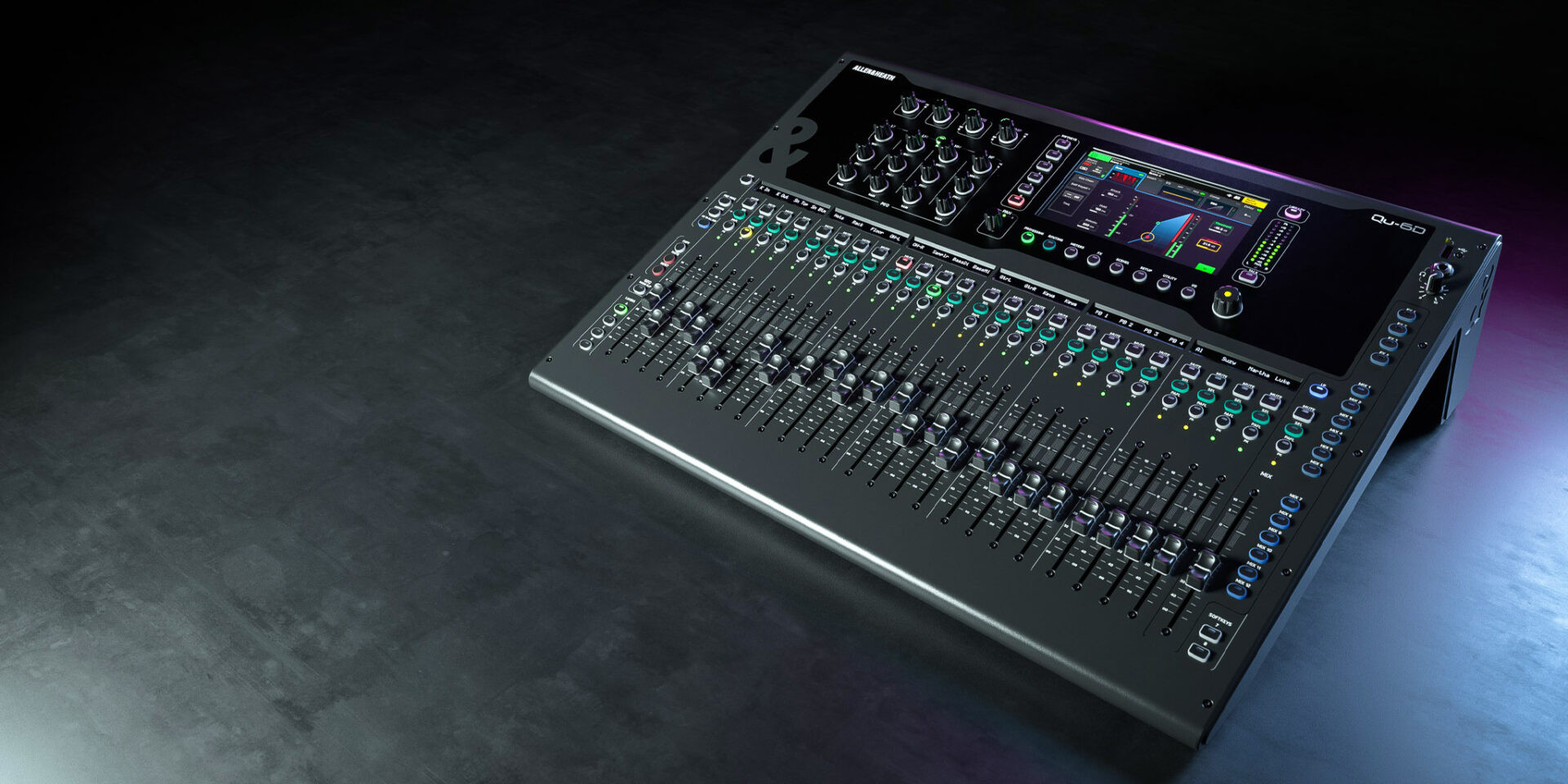
We'll keep the jargon to a minimum, and every time we introduce a technical term, we'll explain it plainly before moving on. No condescension, no assumed knowledge — just a clear path from "I have no idea" to "I understand this well enough to make a smart decision."
What Is a Digital Mixer, and Why Does It Matter?
Let's start right at the beginning. A mixer (or mixing console, or "desk") is the piece of equipment that takes all your sound sources — microphones, guitars, keyboards, playback from a laptop — and blends them together into a balanced result that goes out to your speakers or recording. Think of it like a kitchen: each ingredient (each sound) needs to be measured, adjusted and combined so the final dish sounds great rather than a muddy mess.
For decades, mixers were analogue, meaning every knob physically controlled the electrical signal. A digital mixer like the Qu-6d converts your sounds into digital data the moment they arrive, then processes everything with tiny onboard computers. This matters for three big reasons:
- Recall. You can save an entire show — every level, every setting — and load it back instantly next week. On an analogue desk, you'd have to reset dozens of knobs by hand every single time.
- Built-in processing. Tools that once required racks of expensive outboard gear (compressors, equalisers, reverb) are built right in, on every channel.
- Remote control. You can mix from a tablet while walking around the room, hearing exactly what your audience hears.
The Allen & Heath Qu-6d sits in the sweet spot of the digital mixer world: powerful enough for serious professional work, but approachable enough that a motivated beginner can grow into it.
Decoding the Name: What All Those Numbers Mean
The full product title is a mouthful: "Qu-6d, 32ch, 96kHz Mixer, 25 Faders, 24/16 Local I/O, 6FX, 16x16 Dante." Let's translate that, piece by piece, because once you understand this, the whole product makes sense.
"32 Channels"
A channel is simply one path for one sound source. Thirty-two channels means the Qu-6d can handle 32 separate things at once — say, a full band with drums (which alone might use 8 microphones), several vocalists, guitars, keys and backing tracks. For most pubs, clubs, houses of worship, schools and function bands in Australia, 32 channels is genuinely generous.
"96kHz"
This is the sample rate — how many times per second the mixer measures your incoming sound to turn it into digital data. 96kHz means 96,000 times a second. Higher numbers generally mean more detail and headroom in how the audio is captured and processed. You don't need to obsess over this figure; just know that 96kHz is a premium, high-resolution standard, and many mixers in this price range only run at 48kHz (half the rate).
"25 Faders"
A fader is the sliding volume control — the thing you push up and down. Physical faders matter because they let you grab and adjust sounds instantly with your hands, rather than tapping through menus. Twenty-five faders (24 for channels plus a master) gives you plenty of hands-on control, and they're motorised, meaning they physically move on their own when you switch views or load a saved show. That's a genuinely lovely feature that makes mixing faster and more intuitive.
"24/16 Local I/O"
"I/O" means inputs and outputs — the sockets on the back. "24/16 local" means 24 microphone/line inputs and 16 outputs built right into the desk itself ("local" as opposed to connected over a network). Inputs are where your microphones and instruments plug in; outputs send sound to your main speakers, stage monitors, recording gear and so on.
"6FX"
This means six effects engines. Effects are the polish you add to sound — reverb (that sense of space, like singing in a hall), delay (echo), and so on. Having six independent effects running at once means you can, for example, put a lush reverb on lead vocals, a shorter one on backing vocals, and a slap-back delay on a guitar, all simultaneously.
"16x16 Dante"
This one deserves its own section — keep reading.
What Is Dante, and Why Is Everyone Talking About It?
Dante is the single most important "grown-up" feature on this mixer, and it's worth understanding even as a beginner because it's rapidly becoming the industry standard.
In simple terms, Dante is a way of sending many channels of audio down a single ordinary network cable — the same type of Ethernet cable that connects a computer to the internet. "16x16" means the Qu-6d can send 16 channels and receive 16 channels over this network connection.
Why does that matter? Imagine you're running sound for an event 30 metres from the stage. The old way meant a thick, heavy, expensive "multicore" cable — sometimes as fat as your arm — carrying dozens of individual audio lines. With Dante, that same job is done by one thin network cable. It's lighter, cheaper, far less prone to problems, and lets you build flexible systems where mixers, stage boxes and recording rigs all talk to each other easily.
New to this? Here's the key takeaway: you don't have to use Dante to enjoy the Qu-6d. You can absolutely run it as a standalone mixer with the 24 local inputs on the back. But having Dante built in means the desk is ready to grow with you as your setups get more ambitious — and it's a big reason this mixer represents genuine long-term value rather than something you'll outgrow in a year.
Understanding the Features That Actually Matter
Marketing loves to bury you in features. Here's an honest look at which ones genuinely benefit a newcomer, and why.
Motorised Faders (Matters a Lot)
As mentioned, these move on their own. When you switch from mixing the main speakers to mixing what the band hears in their monitors, the faders physically jump to the right positions. For a beginner, this is a fantastic learning aid — you can literally see your mix, which builds understanding far faster than staring at numbers on a screen.
Onboard Processing on Every Channel (Matters a Lot)
Every input channel has its own EQ (equalisation — the ability to boost or cut bass, mids and treble to shape a sound), a compressor (which evens out loud and quiet parts so a singer doesn't disappear then blast you), and a gate (which quietens a channel when nothing's happening, reducing unwanted background noise). Having these on every channel is the foundation of professional-sounding results.
The AMM — Automatic Microphone Mixer (Underrated for Beginners)
This is a genuinely helpful feature if you're doing spoken-word events — conferences, panels, church services, weddings with multiple speakers. The Automatic Mic Mixer intelligently turns down microphones that aren't being spoken into, reducing feedback (that horrible squeal) and background noise without you having to ride the faders constantly. For a nervous newcomer, it's like having a helping hand.
Wireless Control via Tablet (Matters a Lot)
The Qu-6d works with Allen & Heath's control apps, so you can mix from an iPad while standing in the audience. This is not a gimmick — the only way to know what your audience truly hears is to be where they are. For learning, it's invaluable.
USB Multitrack Recording (Nice to Have)
You can record every channel individually straight to a USB drive, then take those recordings home to practise mixing at your leisure — a brilliant, low-pressure way to build skills. You can also play multitrack recordings back through the desk for a "virtual soundcheck" without needing the band in the room.
A Beginner-Focused Buying Guide
Now for the honest, practical part: should you buy the Qu-6d, and how do you approach the decision sensibly?
Who the Qu-6d Is Genuinely Right For
- The ambitious beginner who's serious about growing. If you know you're going to be doing this for years — regular gigs, a venue, a growing worship team — buying a capable desk now means you won't hit a wall in twelve months.
- Venues and function bands that need reliable 32-channel capability with room to expand over Dante.
- Anyone who values recall and repeatability — schools, theatres, houses of worship where the same setup happens weekly.
Who Might Want to Start Smaller
Let's be honest: if you're mixing a solo acoustic act or a duo in a tiny café and you're certain your needs will stay small, a compact desk with fewer channels may serve you better and cost less. There's no shame in matching the tool to the job. The Qu-6d rewards people who will actually use its capability.
Common Beginner Mistakes to Avoid
- Buying on channel count alone. More channels aren't automatically better if you'll never fill them. Think about your realistic biggest event.
- Ignoring the learning curve. A powerful desk asks a little more of you upfront. Budget time to learn, not just money to buy.
- Forgetting the accessories. You'll likely need quality cables, possibly a tablet for wireless mixing, and a protective case or cover. Factor these in.
- Grey-market imports. Buying from an authorised Australian retailer means you get local warranty support and gear that's right for our conditions. Cheap overseas deals often cost more in the long run.
Ready to take a closer look at the specifications and current Australian pricing? View the Allen & Heath Qu-6d at MusiconStage and see how it fits your plans.
What to Expect When You're Getting Started
Let's set realistic expectations so there are no nasty surprises.
The Learning Curve — An Honest Assessment
The Qu-6d is designed to be one of the more approachable professional desks, thanks to those hands-on motorised faders and a logical layout. That said, this is professional equipment, so expect a genuine learning period. A realistic picture:
- Week one: Getting sound in and out, understanding the basic signal flow (where sound enters, how it's processed, where it exits). This is very achievable quickly.
- First month: Getting comfortable with EQ, compression and effects, and saving/loading your shows.
- Ongoing: Genuinely mastering the finer art of mixing — that's a lifelong craft, and it's the fun part.
Setup Basics
At its simplest, you plug your microphones and instruments into the inputs on the back, connect your speakers to the main outputs, power up, and start pushing faders. You do not need to understand Dante on day one. Start local, get comfortable, and explore networking when you're ready.
Support and Learning Resources
Allen & Heath is a well-established, respected British manufacturer with excellent documentation, video tutorials and an active worldwide community of users. This matters enormously for a beginner: when you get stuck (and everyone does), answers are easy to find. Buying locally also means you have Australian support to lean on.
Common Questions From Beginners
"Do I need to be technical to use this?"
No — but a willingness to learn helps. If you can follow a recipe and you're patient, you can learn to run this desk. The visual, hands-on nature of the Qu-6d actually makes it easier to grasp than many cheaper, menu-heavy alternatives.
"Is 96kHz something I'll actually hear?"
Honestly, in a live setting the difference is subtle and not the main reason to buy this desk. Think of 96kHz as a mark of a premium, high-quality design rather than a feature you'll consciously notice. The build quality, the faders and the Dante networking are what you'll appreciate day to day.
"What's the difference between this and a cheaper mixer?"
Build quality, sound quality, the tactile motorised faders, the professional feature set, expandability via Dante, and long-term reliability. A cheaper mixer gets sound out of speakers; a desk like the Qu-6d does it dependably, night after night, and grows with you.
"Can it record my gigs?"
Yes — straight to USB, either as a simple stereo recording or as individual multitrack files you can remix later. It's one of the best ways to learn.
Your Growth Path: Where This Mixer Takes You
One of the smartest things about choosing a desk like the Qu-6d as a beginner is that it grows alongside your skills:
- Start: Use the local inputs, learn the basics, run small gigs standalone.
- Grow: Add a tablet for wireless mixing from the room; start using compression, EQ and effects with confidence.
- Expand: Add Dante-connected stage boxes to place inputs on stage and run one thin cable back to the desk; integrate with recording and broadcast systems.
In other words, you're unlikely to "outgrow" this mixer any time soon — which makes it a genuinely sound investment rather than a stepping stone you'll replace.
Final Thoughts: Buying With Confidence
The Allen & Heath Qu-6d is a professional digital mixer that manages the rare trick of being both powerful and welcoming to newcomers. Its motorised faders make mixing visual and intuitive, its onboard processing gives you professional tools on every channel, and its built-in Dante networking means it's ready for wherever your journey leads. Yes, there's a learning curve — but it's a rewarding one, backed by superb resources and a supportive community.
If you're serious about audio and want gear that will respect your growing skills rather than hold them back, this is a mixer worth every bit of your consideration. Take your time, match it honestly to your needs, and buy from an authorised Australian retailer so you're properly supported.
When you're ready to make it yours, explore the Allen & Heath Qu-6d at MusiconStage — the friendly team can help you match it to your setup and answer any lingering questions. Here's to your first mix, and the many great ones to come.