
Allen & Heath Qu-6d Deep Dive: 24 Faders, Dante & 96kHz 2026
Allen & Heath Qu-6d Deep Dive: 24 Faders, Dante & 96kHz 2026
The Allen & Heath Qu-6d sits at an interesting point in the digital mixing landscape. It carries the DNA of the Qu series that earned Allen & Heath a loyal following among Australian sound engineers, but underneath the familiar layout is a genuinely re-engineered platform: a 96kHz signal path, native 64x64 Dante, and a dual-touchscreen control surface that changes how you actually work behind the desk. If you're weighing up whether the Qu-6d earns its place in your rack or front-of-house position, this is a technical look at what the specifications really mean in practice.
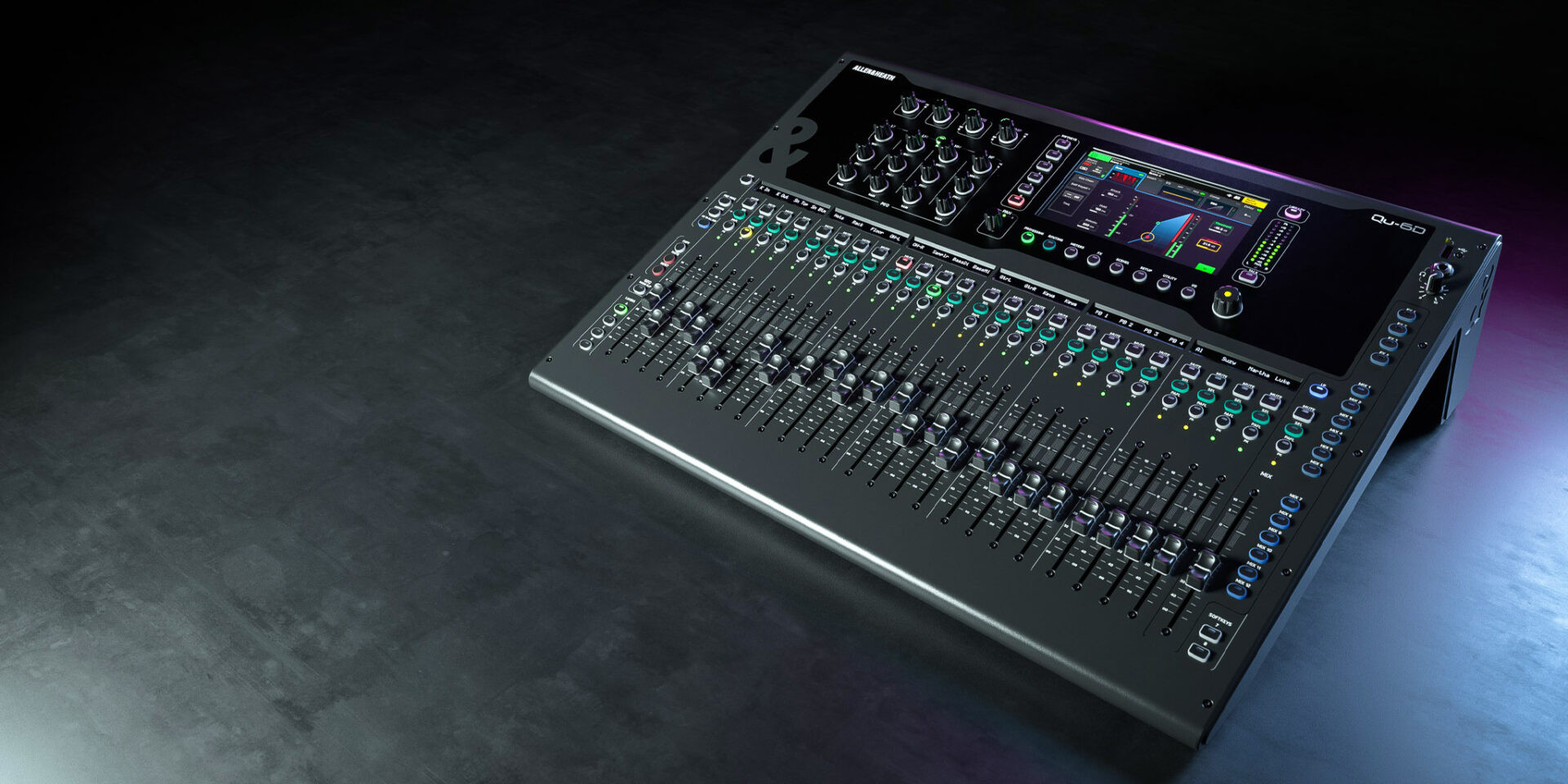
Where the Qu-6d Fits in the Qu Range
The 'd' in Qu-6d is the headline. The original Qu series ran at 48kHz with FireWire and later USB connectivity. The new-generation Qu-d consoles — the Qu-5d, Qu-6d and Qu-7d — move to a 96kHz architecture and put Dante audio networking at the centre of the design rather than treating it as an optional card. The Qu-6d specifically gives you a 24-fader surface across a compact chassis, making it the middle child between the smaller Qu-5d and the larger 33-fader Qu-7d.
What this means for a buyer: you're getting the same processing engine and channel count across the range, with the differences coming down to physical fader count, screen real estate and footprint. The Qu-6d is the sweet spot for engineers who want hands-on control of a full band without the desk eating an entire truck pack or FOH riser.
Core Specifications at a Glance
| Specification | Allen & Heath Qu-6d |
|---|---|
| Sample rate | 96kHz |
| Input channels (processing) | 32 mono + stereo returns |
| Mix outputs | Configurable mix/group/matrix buses |
| Physical faders | 24 motorised + master |
| Local I/O | Onboard mic/line preamps and outputs |
| Audio networking | 64 x 64 Dante (primary) |
| Control | Dual capacitive touchscreens |
| USB recording/playback | Multitrack to USB |
| Remote control | Qu-Pad / Qu-You apps, laptop editor |
Why the 96kHz figure actually matters: doubling the sample rate from the original Qu's 48kHz isn't about chasing numbers on a spec sheet. A higher sample rate widens the usable bandwidth and gives the anti-aliasing filters more room to operate above the audible range, which can translate to a slightly more open top end and cleaner handling of transient-rich material like cymbals and acoustic guitar. It also reduces latency through the conversion and processing stages, which is meaningful when you're feeding in-ear monitors where every millisecond of round-trip delay is felt by the performer.
The Dante Backbone: 64x64 as Standard
This is the single biggest reason to consider a Qu-6d over an older Qu-16, Qu-24 or Qu-32. Dante is the de facto standard for networked audio in professional installs and touring, and having 64 channels in and 64 out built into the console rather than bolted on via an expansion card is a structural advantage.
In real-world terms, this 64x64 capacity lets you:
- Run a stagebox over a single Cat5e/Cat6 cable — pair the Qu-6d with Allen & Heath's DX or AB-series racks and you've replaced a multicore snake with a thin network cable, with full remote preamp control from the surface.
- Split audio to a broadcast or recording rig without analogue Y-splits, because Dante streams can be subscribed by multiple devices on the network.
- Integrate into a larger Dante ecosystem — DSP, amplifiers, other consoles and recording interfaces all speak the same protocol, so the Qu-6d becomes a node rather than an island.
A practical note on network design: Dante is robust but unforgiving of bad networking. Use a managed gigabit switch with the right QoS settings, keep clocking sources clear (one master clock on the network), and don't run Dante over a shared office network. Get the infrastructure right and the Qu-6d behaves flawlessly; get sloppy with cheap unmanaged switches and you'll chase dropouts that have nothing to do with the console.
The Dual-Touchscreen Workflow
The control surface is where the Qu-6d departs most visibly from the older Qu generation. Instead of a single screen and a bank of dedicated rotary encoders, the Qu-6d uses two capacitive touchscreens. The design intent is to let you keep a persistent view — say, your meter bridge or a custom layout — on one screen while you dive into processing on the other.
From an engineering-workflow perspective, this matters more than it might sound. On a busy mix you're constantly context-switching: gain, EQ, dynamics, sends to monitors, effects. A two-screen layout reduces the number of menu dives required to get from one task to the next, and that directly affects how fast you can respond when something goes wrong mid-set. The capacitive screens support familiar pinch-and-swipe gestures, so adjusting an EQ curve feels closer to working on a tablet than navigating a traditional menu tree.
The 24 motorised faders recall instantly when you change layers or select a different bus to mix, so the physical surface always reflects the current state. For monitor engineers in particular, being able to flip between mixes and see the faders snap to position is far quicker and less error-prone than working entirely in software.
Processing and Channel Tools
Each input channel carries the processing tools you'd expect from a modern Allen & Heath desk: a high-pass filter, gate, four-band parametric EQ with high and low shelving options, and compression. The dynamics and EQ are derived from the same design philosophy that runs through the SQ and dLive ranges, so the character is musical rather than clinical.
On the output side you get graphic and parametric EQ on the masters, plus the onboard FX engines for reverbs, delays, modulation and the like. For most live applications — corporate AV, houses of worship, pubs and clubs, school productions and small-to-mid touring — this onboard toolkit is comprehensive enough that you rarely need outboard gear.
What to be realistic about: the Qu-d series is a workhorse console, not a flagship. If you need the deep plug-in-style processing, scene automation depth and channel count of a dLive or even an SQ with extra racks, the Qu-6d isn't pretending to be that. Its strength is delivering a clean, fast, reliable mix with professional tools in a package that one engineer can carry, set up and operate without a tech crew.
Qu-6d vs Older Qu and Sibling Models
| Feature | Qu-6d | Qu-5d | Qu-7d | Original Qu-24 |
|---|---|---|---|---|
| Sample rate | 96kHz | 96kHz | 96kHz | 48kHz |
| Faders | 24 | Fewer | 33 | 24 + master strip |
| Dante | 64x64 built-in | 64x64 built-in | 64x64 built-in | Optional card |
| Control | Dual touchscreen | Touchscreen | Dual touchscreen | Single touchscreen |
| Best for | Full-band live, IEM mixing | Compact rigs | Larger productions | Legacy/budget builds |
If you already own an older Qu and you're happy at 48kHz with analogue snakes, there's no urgency to upgrade. But if you're buying new, building a Dante-based rig, or you want the lower latency and dual-screen workflow, paying for the 'd' generation is the smarter long-term call. Audio networking is only becoming more central to professional installs, and a console without native Dante looks increasingly dated next to one that has it as standard.
Real-World Performance Expectations
Where the Qu-6d shines is reliability under pressure. Allen & Heath consoles have a deserved reputation in the Australian live scene for booting fast, holding scenes safely and not surprising you mid-show. The motorised faders, instant recall and clear metering mean you spend your attention on the mix rather than fighting the interface.
For a typical pub band gig — say 16 to 24 inputs of drums, bass, two guitars, keys and vocals — the Qu-6d has ample headroom on channel count and processing. Push it into a corporate event with playback, multiple wireless mics, video feeds and IEM monitor mixes and it still has room to move. The 64x64 Dante means that as your input list grows, you add a stagebox rather than running out of physical sockets.
Multitrack recording is worth flagging for anyone doing virtual soundchecks or capturing live sets: the Qu-6d records multitrack to USB, and combined with Dante you can also stream to a DAW for full-session capture. That makes it a genuine tool for bands wanting to build a live album or for engineers who like to refine a mix at home before the next show.
Technical Considerations Before You Buy
- Plan your network first. A Qu-6d in a Dante rig is only as good as the switch and cabling behind it. Budget for a proper managed gigabit switch and quality Cat6.
- Match the desk to your I/O reality. The console's onboard sockets cover a lot, but if your stage is far from FOH, factor in a DX or AB stagebox to exploit the Dante backbone.
- Consider future-proofing. Buying into 96kHz and native Dante now means the desk stays relevant as your rig and the wider industry standardise on networked audio.
- Think about who's driving it. The dual-touchscreen workflow is fast once learned, but give yourself a rehearsal or two to build muscle memory before a high-stakes show.
Ready to spec one for your rig? You can view the Allen & Heath Qu-6d at Music On Stage for current Australian pricing and availability.
Technical FAQs
Is the Qu-6d a true 96kHz console end to end?
Yes — the signal path, processing engine and Dante network all operate at 96kHz, which lowers latency and improves the conversion stage compared to the 48kHz original Qu series.
Can I use the Qu-6d without a Dante network?
Absolutely. The onboard local I/O lets you run the console as a standalone desk with analogue inputs and outputs. Dante simply unlocks networked stageboxes, multi-device splits and DAW integration when you need them.
How many monitor mixes can I run?
The Qu-6d's configurable buses give you plenty of mixes for a full band's worth of wedges and in-ears, and the Qu-You app lets performers tweak their own monitor mix from a phone, taking load off the engineer.
Does it integrate with Allen & Heath stageboxes?
Yes — pair it with DX or AB-series racks over Dante for remote preamp control and a single-cable run to stage. This is the intended way to scale your input count.
The Verdict for Technical Buyers
The Allen & Heath Qu-6d is a console that knows exactly what it is: a compact, fast, reliable 24-fader desk built around modern 96kHz processing and native Dante networking. It won't replace a flagship for the largest productions, but for the enormous middle ground of Australian live sound — bands, venues, corporate AV, worship and education — it delivers professional results with a workflow that respects your time behind the desk.
If your priorities are clean audio, low latency, future-proof networking and a control surface that keeps up with a busy mix, the Qu-6d is one of the strongest options in its class. Check the Qu-6d's full details and pricing at Music On Stage and weigh it against your input list and network plans before you commit.