
Allen & Heath Qu-24 vs The Field: Aussie Mixer Showdown 2026
Allen & Heath Qu-24 vs The Field: Aussie Mixer Showdown 2026
Buying a mid-format digital mixer is one of the more awkward decisions in live sound. Below about 16 channels, the choices are cheap enough that a mistake stings but doesn't hurt. Above 32, you're usually spending someone else's money and the brief is written for you. The 24-channel bracket sits right in the messy middle — it's where a growing band, a busy function venue or a hire company starts committing real capital, and where the differences between brands stop being marketing copy and start being things you feel at 11pm on a Saturday.
The Allen & Heath Qu-24 has been a fixture in this bracket for years, which cuts both ways. It means a mature, heavily debugged platform with an enormous installed base — and it also means it's competing against products designed a good deal more recently. This guide works through what you actually get, where it wins, where newer rivals have moved past it, and how to decide which side of that line your situation falls on.
The 24-Channel Bracket: What You're Actually Choosing Between
Before comparing specific units, it helps to understand that "24-channel digital mixer" describes at least three fundamentally different products, and buyers regularly cross-shop them without realising they're not equivalent.
The three archetypes
- Full-surface consoles — motorised faders, a physical channel strip, screen and knobs. You mix with your hands. The Qu-24 lives here. More expensive per channel, but fastest to operate under pressure.
- Rack/headless mixers — the same DSP in a rack box, controlled from a tablet. Cheaper, lighter, brilliant for installs and one-person operations, but you're dependent on a wireless link and a touchscreen for everything.
- Hybrid touchscreen mixers — a smaller physical surface with a large integrated touchscreen doing most of the work. The newer generation of compact digital mixers largely sits here.
None of these is inherently better. The question is whether you need tactile immediacy — the ability to grab a fader without looking — or whether you're happy trading that for size, weight and price. If you're mixing a band you know well from front-of-house, a surface earns its keep. If you're wandering a room tuning a corporate speech system, a tablet is arguably superior.
Where the Qu-24 Sits
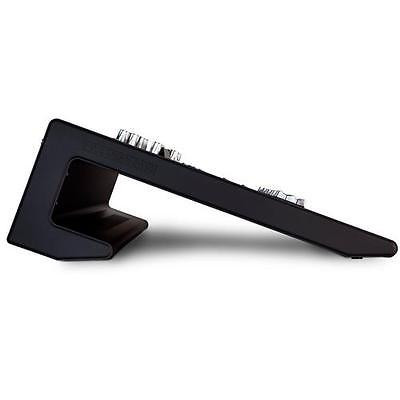
The Qu-24 is a full-surface console with a motorised fader per input channel plus masters, a touchscreen, and Allen & Heath's AnalogiQ preamps. Its defining characteristic is that it was designed by a company whose core business is live sound consoles, for people who mix live sound for a living — and that shows up in the ergonomics more than the spec sheet.
What the Qu-24 does genuinely well
- Fader-per-channel workflow. On a 24-input show, having every input under a dedicated fader eliminates layer-flipping. This is the single biggest practical advantage over cheaper rack mixers and smaller-surface hybrids, and it's the thing people underestimate until they've mixed a chaotic changeover.
- Onboard multitrack recording to USB. Recording the entire show to a connected drive, then playing it back through the desk for virtual soundcheck, is enormously useful — for training, for line-checking a room before doors, and for giving bands a rough live recording as a value-add.
- Preamp quality. Allen & Heath's reputation here is earned. The preamps are clean and forgiving with dynamic mics, which matters more than most spec comparisons suggest.
- Stagebox expansion. Pairing with a remote AudioRack over a single cable to run inputs from stage is a genuine workflow upgrade and cuts your multicore problem down considerably.
- Enormous installed base. Every second engineer in Australia has driven one. If you hand it to a guest engineer or a casual, odds are good they'll be productive within minutes. That is worth real money to hire companies and venues.
- Proven reliability. Years in the field, firmware long since matured. There is a lot to be said for a platform where the unknown-unknowns have already been found by someone else.
Where the Qu-24 shows its age
Balanced reviewing means saying this plainly. The Qu series is a mature design, and the market has moved.
- Sample rate and processing generation. Newer consoles in and around this price band run higher sample rates and more modern processing engines. Whether you can hear the difference on a pub PA is genuinely debatable — but if you're buying for a decade, it's a real consideration.
- Screen size and resolution. The touchscreen is functional rather than luxurious. Rivals released more recently offer noticeably larger, sharper displays with more information visible at once.
- Networking. Modern audio-over-IP expectations have risen. If Dante or a comparable networked audio protocol is central to your plans, check the exact configuration and card options on the unit you're buying rather than assuming.
- Size and weight. A 24-fader surface is not a one-hand carry. If you're a solo operator doing three loads-in a week up stairs, this is a daily tax.
- Price per channel. A rack mixer with the same input count will almost always undercut it. You're paying for the surface.
Head-to-Head: Qu-24 vs the Realistic Alternatives
Qu-24 vs a rack-format mixer of the same channel count
| Factor | Qu-24 (full surface) | Rack/headless mixer |
|---|---|---|
| Speed under pressure | Clear winner — hands on faders | Slower; touchscreen and layers |
| Price | Higher | Typically meaningfully lower |
| Transport & setup | Bulky, two-person friendly | Excellent — fits in a rack, light |
| Wireless dependency | None required | Total — Wi-Fi is your control surface |
| Handing to a guest engineer | Straightforward | Requires app setup and trust |
| Room-walking / tuning | Possible via app | Native strength |
| Best for | FOH engineers, bands, venues | Installs, solo ops, tight budgets |
Verdict: This is the most important fork in the road, and it's not about money — it's about how you work. If someone is standing at the desk for the whole show, buy the surface. If the mixer lives in a rack and you're on a tablet anyway, the surface is dead weight you paid for.
Qu-24 vs the newer compact touchscreen generation
| Factor | Qu-24 | Newer touchscreen mixers |
|---|---|---|
| Physical faders | One per input — major advantage | Fewer; more layer navigation |
| Processing generation | Mature, proven | Newer engines, higher sample rates |
| Screen | Adequate | Generally larger and sharper |
| Learning curve | Conventional, console-like | App-like; easier for newcomers |
| Resale & familiarity | Very strong installed base | Growing, less established |
| Longevity of platform | Later in its lifecycle | Earlier — longer support runway |
| Best for | Hands-on mixing, multi-operator use | Newcomers, future-proofing, portability |
Verdict: Honest answer — if your input count genuinely approaches 24 and you mix by hand, the Qu-24's fader count still beats a newer mixer with half the faders. If you're regularly running 12–16 inputs, the newer generation is the smarter long-term buy.
Qu-24 vs a 16-channel console (the temptation to save)
A lot of buyers land on the Qu-24 page after pricing a 16-channel unit and wondering whether the step up is justified. The honest test is arithmetic, not ambition.
Count your worst-case input list. A five-piece band with a real drum kit is commonly 16–18 inputs before you've plugged in a laptop, a spare vocal or a guest act's DI. A 16-channel mixer is full at that point, with nothing left for the support band or the unexpected. If your realistic worst case is over about 14 inputs, the 24 is the correct buy — running a desk permanently at capacity is how shows go wrong.
If your worst case is genuinely 10–12 inputs and has been for two years, buying 24 channels is buying insurance you'll never claim, and the money is better spent on monitors, mics or a stagebox.
Qu-24 vs a 32-channel console (the temptation to overbuy)
The opposite mistake. Stepping to 32 channels adds cost, weight, footprint and case size for capacity most operations never touch. It's the right call for festival-adjacent work, theatre, multi-band bills with shared inputs, or houses of worship running full bands plus AV. For a pub circuit band or a function venue, it's usually surplus.
Value Analysis: What You're Actually Paying For
| Spend tier | What you typically get | Suits |
|---|---|---|
| Entry digital | Rack or small-surface, 12–16 in, app control | Duos, solo acts, small rooms, first digital purchase |
| Mid-format surface (Qu-24 territory) | Fader-per-channel, onboard recording, stagebox support, pro preamps | Working bands, venues, hire fleets, schools |
| Upper mid / newer generation | Higher sample rates, better screens, stronger networking | Buyers prioritising longevity and networked audio |
| Large-format | 32+ inputs, expansion, redundancy | Theatres, festivals, large multi-purpose venues |
The Qu-24's value case rests on a specific claim: that faders and familiarity are worth more to you than newest-generation internals. For a venue where five different engineers touch the desk in a month, that claim is easy to defend. For a solo owner-operator buying one console for the next eight years, it's a closer call and worth thinking about honestly.
Total cost beyond the sticker price
| Item | Why it matters |
|---|---|
| Flight case or padded bag | Non-negotiable for mobile use; protects resale value more than anything else |
| Stagebox / AudioRack | Transforms setup speed; often the best second purchase you'll make |
| Reliable USB drive for recording | Cheap drives are the most common cause of failed multitrack captures |
| Wi-Fi router for app control | Don't cheap out — flaky Wi-Fi ruins the remote-mixing experience |
| Cabling & looms | Regularly underestimated; budget for it upfront |
If you're weighing options at this level, it's worth checking current Qu-24 pricing and availability alongside the accessories you'll inevitably need, rather than pricing the console in isolation.
Situation-Specific Recommendations
Best for a working covers or originals band
The Qu-24, if you're carrying your own FOH. Full drum mic-ing plus a horn section or extra vocals eats channels fast, and having every input on a fader makes multi-band nights survivable. The onboard recording is a genuine bonus — live recordings of every gig, for free.
Best for a function venue or club
Strong recommendation. The familiarity argument dominates here. Guest engineers arriving with a touring act will recognise it. Casual staff can be trained on it. That's operationally worth more than a spec advantage.
Best for a house of worship
Depends on volunteer turnover. High turnover with rotating volunteers favours a scene-recall-heavy, layer-light workflow — the Qu-24's fader-per-channel layout is genuinely easier to teach than a layered smaller surface. If your team is stable and technically confident, a newer touchscreen mixer may serve you longer.
Best for installs and fixed systems
Consider a rack format instead. If the console lives in a locked rack and nobody stands at it, you're paying for 24 motorised faders that will never be touched. Put that money into speakers.
Best for a solo mobile operator
Think carefully about weight. The Qu-24 is a two-hands-and-a-trolley item. If you're doing three loads-in a week alone, a rack mixer plus tablet may keep you in the industry longer than the better mixing surface will.
Best for schools and training environments
Excellent fit. Physical faders teach gain structure and balance in a way a touchscreen doesn't. Students who learn on a real surface transfer to other consoles far more easily than students who learn on an app.
A Decision Framework That Actually Works
Work through these in order. Most buyers get the answer by question three.
- Count your worst-case input list, then add four. Not your typical gig — your worst one. If that number exceeds 20, you're in Qu-24 territory or above.
- Decide whether someone stands at the desk. Yes → buy a surface. No → buy a rack and save the money.
- Count the operators. One expert, or many casuals? Many casuals strongly favours a familiar, layer-light console.
- Assess your load-in reality. Stairs, solo, small car? Weight beats features.
- Decide your holding period. Under five years, a mature platform is fine. Ten years, weigh the newer-generation options more heavily.
- Check your networking needs. If Dante-style networked audio is core to your plans, confirm the exact card and configuration before committing.
Common mistakes buyers make in this bracket
- Buying channel count instead of workflow. Two mixers with 24 inputs can be completely different tools. The surface matters more than the number.
- Under-buying by one tier. Running permanently at full capacity means every unexpected input becomes a crisis. Headroom is cheap compared to a ruined show.
- Ignoring the Wi-Fi. People spend thousands on a console and control it through a $40 router. Remote mixing is only as good as the network under it.
- Forgetting the case. An uncased console in a van depreciates fast and fails faster.
- Assuming newest equals better for you. A newer engine you can't hear is worth less than eight faders you use every night.
- Not budgeting for the stagebox. The digital-snake workflow is half the reason to go digital. Plan for it.
Questions worth asking before you buy
- What exactly is the current firmware version, and what does it add?
- Which expansion or networking card, if any, is fitted to this specific unit?
- What's the local warranty position and turnaround on service in Australia?
- Is there a stagebox bundle, and does it work out better than buying separately?
- What's the realistic secondhand value in three years — and how many are on the market now?
- Can I get hands on one before committing? Fader feel and screen legibility are hard to judge from photos.
The Honest Final Recommendation
The Qu-24 is not the newest thing in this bracket, and anyone telling you otherwise is selling. What it is, still, is one of the most operationally sensible mid-format consoles you can buy in Australia — a proper fader-per-channel surface, excellent preamps, mature firmware, useful onboard recording, and a familiarity advantage that no newer competitor can manufacture overnight.
Buy it if: you're regularly running 18–24 inputs, someone stands at the desk and mixes with their hands, multiple people will operate it, and you value a proven platform over the newest internals.
Look elsewhere if: your input count is comfortably under 14, you're a solo operator fighting weight, you mix from a tablet in the room by choice, or you're buying a single console to last a decade and want the longest possible support runway.
Neither of those is the wrong answer — they're just answers to different questions. Be honest about which question you're asking, and the decision makes itself. If you've worked through the framework above and landed on the surface-console side, take a closer look at the Qu-24 and current Australian pricing here — and ask about stagebox bundles while you're at it, because that pairing is where this console really comes into its own.