
Allen & Heath CQ-12T Specs Decoded: 96kHz Touch Mixer 2026
Allen & Heath CQ-12T Specs Decoded: 96kHz Touch Mixer 2026
The Allen & Heath CQ-12T sits at an interesting intersection in the compact digital mixer market: it's small enough to live in a backpack-sized bag, yet it runs the same 96kHz FPGA audio engine that underpins the rest of Allen & Heath's professional CQ range. For Australian musicians, AV technicians and small venues weighing up their first proper digital console, the question isn't really whether the CQ-12T sounds good — Allen & Heath's preamp pedigree settles that — it's whether the I/O count, processing architecture and connectivity actually match the work you do. This guide pulls the specifications apart and explains what each one means in practice.
Technical Overview: What "12 Channel" Actually Means
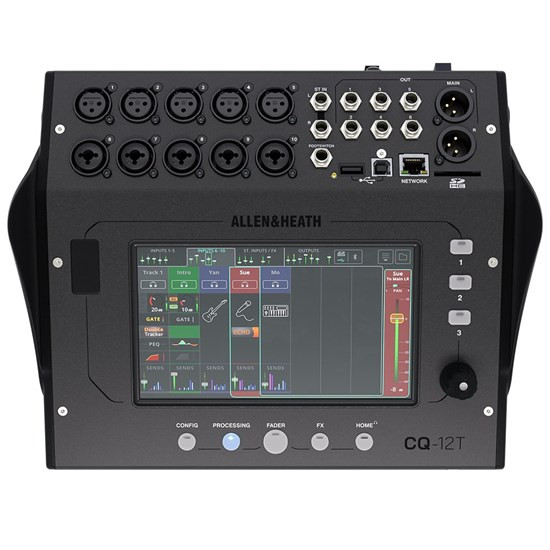
The first thing to understand is that "12 channel" refers to processing channels, not analogue sockets. The CQ-12T gives you 12 fully processed input channels feeding the mix engine, but those channels are populated from a mix of physical inputs and digital sources. Knowing how that breaks down is the difference between buying the right mixer and running out of inputs at your second gig.
| Specification | Allen & Heath CQ-12T | Why It Matters |
|---|---|---|
| Processing engine | 96kHz FPGA (XCVI-derived) | Lower latency and a more natural top end than 48kHz rivals |
| Input channels | 12 processing channels | Enough for a full band plus playback |
| Mic/line preamps | 6 x combo XLR/TRS | Studio-grade recallable gain preamps |
| Stereo line input | 1 x stereo (TRS) | Keyboards, playback devices, backing tracks |
| Bluetooth | Audio streaming + app control | Wireless music input and remote mixing |
| Mix outputs | Main LR + 4 configurable mixes | Monitors, IEMs, zones or FX sends |
| FX engines | 4 stereo (reverb, delay, modulation) | Professional onboard effects, no outboard needed |
| Recording | SD card + USB-C multitrack interface | Capture gigs or use as a computer interface |
| Touchscreen | 5" capacitive colour display | Direct, fast access to channel processing |
| Control | CQ-MixPad app (Wi-Fi/Bluetooth) | Mix from the floor on a tablet or phone |
In real terms, a typical use case looks like this: six mic/line inputs cover vocals and a couple of instruments or a drum overhead pair, the stereo input handles a keyboard or laptop, and Bluetooth brings in walk-in music between sets. That's a self-contained rig for a duo, trio or small four-piece without any external gear.
The 96kHz Engine: Why Sample Rate Isn't Marketing Fluff
Plenty of compact digital mixers in this price bracket run at 48kHz. The CQ-12T runs its entire signal path at 96kHz, and this is genuinely meaningful rather than spec-sheet bragging. A higher sample rate pushes the anti-aliasing filters further above the audible band, which translates to a smoother, less "digital" high frequency response — something you notice on cymbals, acoustic guitars and breathy vocals.
Just as importantly, the CQ-12T uses an FPGA (Field Programmable Gate Array) rather than a general-purpose DSP. An FPGA processes audio in dedicated hardware logic, which keeps round-trip latency low and consistent regardless of how much processing you load onto each channel. For anyone monitoring through in-ear monitors, low and predictable latency is critical — even a few milliseconds of variable delay can make IEM monitoring feel disconnected. This is the same architectural philosophy that runs through Allen & Heath's larger SQ and Avantis consoles, scaled down.
Channel Processing: Console-Grade Tools Per Input
Where the CQ-12T earns its keep against analogue mixers and cheaper digital units is the processing available on every channel. You're not rationing one compressor across the desk — each input channel carries a full processing chain:
- High-pass filter — clean up stage rumble and mic handling noise
- Gate — control bleed on drums and tighten up noisy sources
- Parametric EQ — surgical tonal shaping with sweepable bands
- Compressor — even out dynamics on vocals and bass
Output and mix busses add graphic and parametric EQ plus limiting, so you can ring out monitor wedges and protect your speakers from clipping. For a mixer this size, that's a comprehensive toolkit that would have required a rack full of outboard gear two decades ago.
Gain Assistant and Feedback Assistant: Automation That Earns Its Place
Two of the CQ-12T's standout features are its automated setup tools, and they deserve technical scrutiny because "automatic" features are often gimmicks. These aren't.
Gain Assistant listens to each input and sets a sensible preamp gain level for you. For solo operators — the musician who is also the sound engineer — this removes one of the most error-prone parts of soundcheck. It won't replace an experienced engineer's ear for headroom, but it gets you to a safe, usable starting point in seconds rather than guessing.
Feedback Assistant identifies problem frequencies and helps you notch them out before they ring out of control. In acoustically difficult Australian rooms — think tiled-floor function venues, RSL function rooms and reverberant community halls — this is a practical safety net for floor monitors and lapel mics. The honest caveat: it's a tool, not a miracle. Aggressive feedback suppression always costs some tonal quality, so it's best used to buy headroom, not to paper over bad monitor placement.
Recording and Connectivity: SD, USB-C and Bluetooth
The CQ-12T is built around three connectivity pillars, and understanding the distinction between them matters for buyers planning to record:
- SD card recording — capture a stereo recording of your gig directly to card with no computer involved. Perfect for archiving performances or pulling a quick reference mix.
- USB-C multitrack interface — connect to a Mac or PC and stream multiple channels in and out for full multitrack recording in your DAW, or for virtual soundcheck. This turns the mixer into a legitimate recording front-end.
- Bluetooth — streams audio in (background music, playback) and supports wireless app control.
The multitrack USB capability is the sleeper feature here. It means a covers band can record every show, take the multitrack home, and remix or use it to refine their live mix — a workflow that simply isn't possible on an analogue desk without expensive add-ons.
If you want to see the current Australian pricing and stock, the Allen & Heath CQ-12T product page at MusiconStage has the full listing.
Touchscreen and App Control: The Interface Philosophy
The 5" capacitive touchscreen is the heart of the CQ-12T's user experience. Rather than the menu-diving you get on cheaper digital mixers, the touchscreen gives you direct visual access to channel processing — tap a channel, see its EQ curve, drag it where you want it. It's not as physically tactile as a desk full of faders, but for a compact mixer it's a fast, modern way to work.
The real flexibility comes from the CQ-MixPad app. Connect over Wi-Fi (via a router) and you can walk the room with a tablet, setting monitor levels from the stage and tuning the front-of-house mix from where the audience actually stands. For solo performers and small crews, this remote control capability is arguably more valuable than any single onboard feature — you can EQ a wedge while standing in front of it.
How the CQ-12T Compares Within the Range
Buyers almost always cross-shop the CQ-12T against its larger siblings. Here's the technical decision framework:
| Model | Best For | Key Difference |
|---|---|---|
| CQ-12T | Solo acts, duos, small bands, AV | Most portable; 6 preamps; 5" screen |
| CQ-18T | Full bands, busier stages | More preamps and physical I/O |
| CQ-20B | Install, headless, app-driven rigs | Rack-mount, no screen, built-in Wi-Fi, more I/O |
All three share the same 96kHz engine, the same processing quality and the same app. So the choice is purely about input count and form factor, not sound quality. If your channel count comfortably fits inside the CQ-12T's I/O, you're getting identical audio performance to the bigger units in a smaller, cheaper package. The trap to avoid is buying the CQ-12T to save money and then constantly fighting input limitations — count your sources honestly before deciding.
What Specifications Actually Matter for Your Decision
If you're evaluating the CQ-12T against competing compact digital mixers, here are the specifications worth weighing — and the ones that are mostly noise:
- Preamp count and quality (matters a lot) — six recallable Allen & Heath preamps is a genuine strength. Cheaper mixers often skimp here.
- Sample rate and processing type (matters) — 96kHz FPGA is a real advantage for latency and top-end clarity.
- Per-channel processing (matters) — full dynamics and EQ on every channel, not a shared pool.
- Multitrack recording (matters if you record) — USB-C interface plus SD card covers both casual and serious capture.
- Number of faders (less relevant here) — this is a touchscreen-led design, so don't judge it by physical control surface alone.
The honest red flag to watch on any compact mixer is input padding — manufacturers quoting a high "channel" count that's mostly made up of Bluetooth and USB returns rather than real preamps. The CQ-12T is upfront about its six physical preamps, which is the spec that determines how many live sources you can actually mic up.
Real-World Suitability for Australian Users
For the Australian gigging landscape — pubs, clubs, RSLs, weddings, churches and corporate AV — the CQ-12T hits a genuine sweet spot. Its portability suits the reality of load-in at venues with stairs and tight stages, its app control suits one-person operations, and its onboard FX mean you can leave the outboard rack at home. Acoustic duos, solo loopers, function-band keyboardists and small church AV teams are the clearest fit.
Where you'd step up to the CQ-18T or CQ-20B is the moment you're regularly miking a full drum kit alongside a full band — that's when six preamps starts to feel tight. For everything below that threshold, the CQ-12T delivers professional Allen & Heath audio in the most travel-friendly form the range offers.
Ready to make the call? You can check current availability of the CQ-12T at MusiconStage and talk to their team about whether it suits your specific input requirements.
Frequently Asked Questions
Does the CQ-12T need a computer to operate?
No. The onboard 5" touchscreen lets you run the entire mixer standalone. The computer is only needed if you want to use the USB-C multitrack recording interface or DAW integration.
Can I mix from my phone or tablet?
Yes. The CQ-MixPad app gives you full remote control over Wi-Fi, including walking the room to set monitor and front-of-house levels independently. Bluetooth is also supported for control and audio streaming.
Is 96kHz really better than 48kHz for live sound?
The benefits are subtle but real: smoother high-frequency response and lower, more consistent latency. For in-ear monitoring and detailed acoustic sources, it's a worthwhile advantage rather than a marketing line.
How many microphones can I actually connect?
The CQ-12T provides six combo XLR/TRS preamps for microphones or line sources, plus a separate stereo line input and Bluetooth. Six is the practical mic count for live sources.
Can I record my gigs without extra gear?
Yes — record a stereo mix straight to SD card with no computer needed. For full multitrack capture, connect via USB-C to a Mac or PC.
The Verdict: A Compact Mixer That Doesn't Compromise on Engine Quality
The Allen & Heath CQ-12T's greatest technical achievement is that it makes almost no audio-quality compromises to achieve its small size. You get the same 96kHz FPGA engine, the same per-channel processing depth and the same app ecosystem as the larger CQ models — the only thing you trade away is physical input count and a control surface full of faders. For solo performers, duos, small bands and compact AV setups across Australia, that's an outstanding trade. Buy it for the right channel count and the CQ-12T will out-perform anything else this portable in its class.